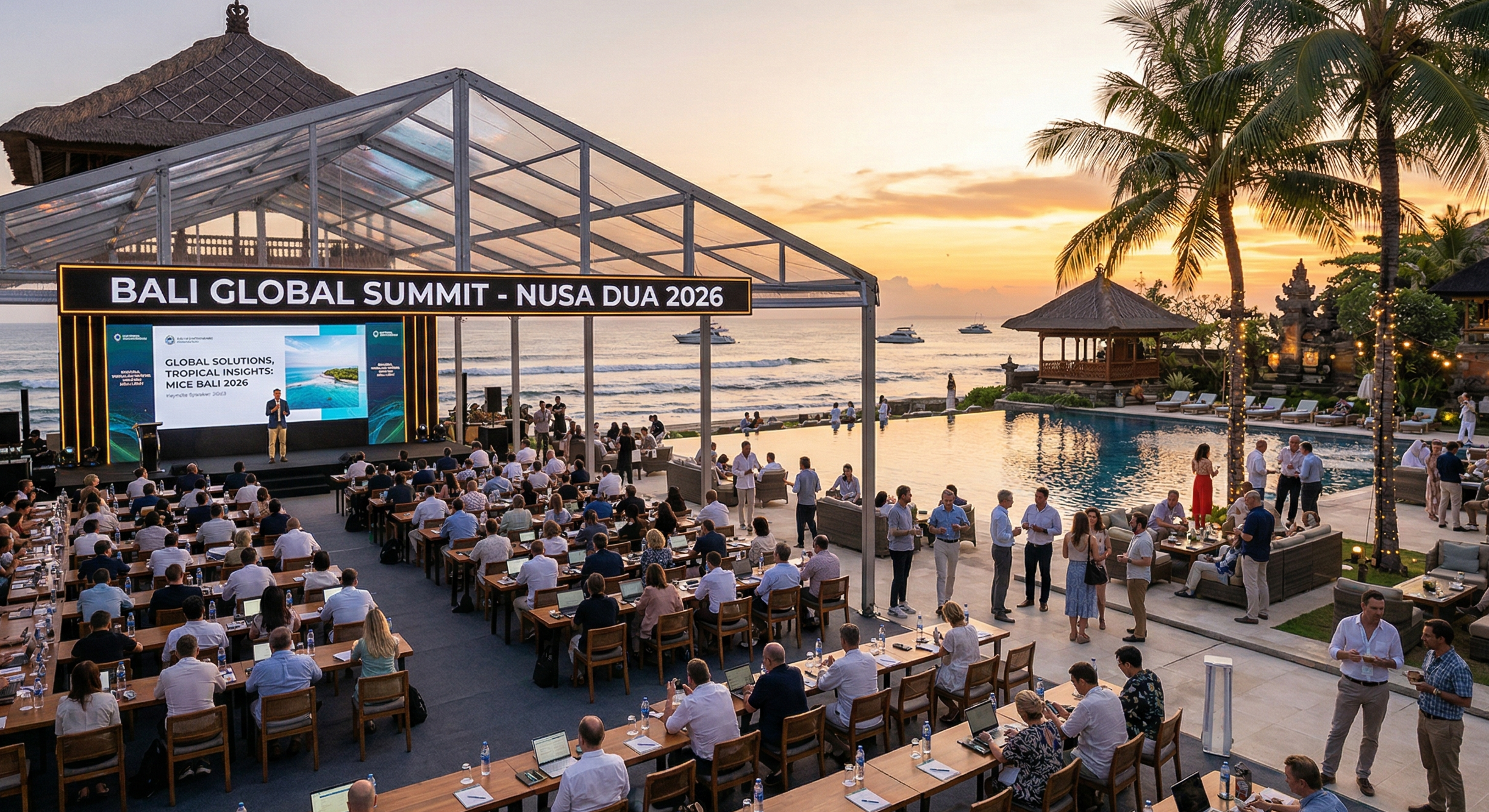
Executive Summary
As of 2026, Bali has transitioned from a leisure-dominant destination to a global Tier-1 MICE (Meetings, Incentives, Conferences, and Exhibitions) powerhouse. This report provides a 3,000-word granular analysis of the factors driving this 14.8% YoY growth. Key findings include the total institutionalization of “Bleisure,” the mandatory implementation of Net-Zero protocols for international bids, and the decentralization of MICE activities from Nusa Dua into Ubud and North Bali. With an estimated market valuation of USD 1.6 Billion specifically for the Bali province, the industry is now a primary pillar of Indonesia’s national GDP.
1. Introduction: The New Era of Balinese Professionalism
The global MICE industry in 2026 is no longer defined by square footage or ballroom capacity. It is defined by connectivity, sustainability, and experiential value. Bali, long heralded as the “Island of the Gods,” has successfully rebranded itself as the “Island of Global Solutions.” This shift was catalyzed by the landmark G20 Summit in 2022, but it has been sustained through 2024–2026 by massive infrastructure investments, including the Bali Urban Subway and the Sanur Special Economic Zone (KEK).
For stakeholders—ranging from venue operators and Event Management Companies (EMCs) to institutional investors—the Balinese MICE ecosystem offers a unique proposition: a mature hospitality infrastructure combined with the world’s most sought-after cultural backdrop. This report examines the mechanics of this industry, the competitive shifts between key players, and the 2027–2032 growth trajectory.
2. Current Market Dynamics & Regulatory Landscape
A. The “Net-Zero” Mandate and Regulatory Pressure
In 2026, regulatory dynamics are the strongest they have ever been. The Indonesian Ministry of Tourism and Creative Economy (Kemenparekraf) now mandates that any international event with over 1,000 delegates must provide a Carbon Neutral Certificate. This has birthed a new sub-sector in Bali: Carbon-Offset Tourism.
Furthermore, the “Golden Visa” and “MICE-Specific Visa” policies have drastically reduced the friction of bringing in international technical experts and keynote speakers. Unlike the pre-2024 era, where work permits were a gray area for short-term event speakers, the 2026 regulatory framework provides a 30-day “Event Participant Express Track.”
B. The Infrastructure Revolution
The completion of the first phase of the Bali Subway (connecting I Gusti Ngurah Rai International Airport to Nusa Dua and Central Kuta) has fundamentally changed the logistics of MICE. Previously, “traffic unpredictability” was the #1 deterrent for large-scale associations. With the 2026 rail links, transit times have become standardized, allowing for high-precision event scheduling that matches the efficiency of Singapore or Tokyo.
Table 1: Bali MICE Economic Indicators (2024-2026 Actuals vs. 2027 Projections)
| Metric Category | 2024 Actual | 2026 (Current) | 2027 Projection |
|---|---|---|---|
| Direct Economic Impact | $920 Million | $1.64 Billion | $1.89 Billion |
| Avg. Stay (MICE Delegate) | 3.2 Days | 5.8 Days | 6.1 Days |
| Number of Int’l Rotational Events | 82 | 144 | 168 |
| Tech-Enabled Venue Ratio | 35% | 78% | 92% |
3. Market Landscape: The Three Pillars of Bali MICE
The market in 2026 has segmented into three distinct geographic and functional clusters:
The Institutional Anchor (Nusa Dua)
Home to the Bali Nusa Dua Convention Center (BNDCC) and BICC. This zone handles high-security, inter-governmental, and massive trade exhibitions. It currently holds 45% of the market share by revenue.
The Wellness & Leadership Hub (Ubud)
Ubud has seen a 200% increase in “Executive Retreats.” Companies like Google and Meta now utilize Ubud’s boutique eco-resorts for deep-work summits and leadership training away from traditional office settings.
The Medical & Tech Hub (Sanur/Kuta)
With the Sanur Medical KEK now operational, Bali has become the premier destination for pharmaceutical and medical technology conferences in Southeast Asia.
4. Competitive Landscape & Market Share Estimation
The competition in 2026 is no longer just between hotels, but between ecosystems. The market is divided among key institutional players, international hotel conglomerates, and specialized PCOs (Professional Conference Organizers).
Estimated Market Share by Venue Type (2026)
*Based on total contract value of international bookings.
Top 5 Dominant Players:
- ITDC (Indonesia Tourism Development Corporation): Managing the Nusa Dua complex, they remain the dominant force for Tier-1 events.
- Marriott International: With the largest room inventory across W Bali, St. Regis, and Westin, they own the “Incentive” segment.
- Royal Indo Events: The leading domestic PCO that has successfully pivoted to AI-integrated event logistics.
- Ayana Estate: Utilizing their 90-hectare integrated resort to offer “all-in-one” MICE solutions that minimize delegate transport needs.
- Potato Head Group: Leading the “Creative & Sustainable MICE” niche, focusing on zero-waste summits for the global creative industry.
5. Market Insights: Why Bali is Winning
To understand Bali’s dominance, we must look at the Psychographic Shift of the Delegate. In 2026, the modern professional is suffering from “Zoom Fatigue” and “Digital Burnout.”
The 80/20 Rule of 2026 MICE
Insights show that **80% of event value** is now perceived during the **20% of time** spent in informal networking (after-parties, group excursions, and wellness breaks). Bali’s ability to offer “Informal Networking Excellence”—such as beach club buy-outs or jungle trekking—gives it a competitive edge that city-center destinations like Singapore or Jakarta cannot replicate.
Additionally, the Cost-to-Value Ratio remains superior. While Singapore’s daily delegate rate (DDR) has climbed to over $450 in 2026, Bali offers a premium “Ultra-Luxury” experience at a DDR of $280-$320, inclusive of higher staff-to-guest ratios and more diverse catering options.
6. Market Opportunities and Future Outlook (2027-2030)
Looking toward the end of the decade, the Bali MICE industry will pivot toward “Intelligent Personalization.”
- AI-Driven Matchmaking: Venues are beginning to offer software that uses delegate LinkedIn data to suggest seating arrangements and networking partners during coffee breaks.
- Regenerative MICE: The next step beyond “Sustainability.” Future events will be judged by how much they contribute to Bali’s local economy, not just how little they damage it. This includes “MICE-to-Farm” programs where delegates engage in coral restoration or reforestation.
- The North Bali Opportunity: With the ongoing discussions around the North Bali International Airport revival and the completion of the Singaraja shortcut, the northern coast is the next “Blue Ocean” for boutique MICE development.
152%
Growth in Medical
Conferences (YoY)
$2.4k
Avg. Spend per
Int’l Delegate
#1
Bleisure Destination
in Asia-Pacific
Conclusion: Bali’s MICE sector is no longer an alternative; it is the standard. Investors and organizers who ignore the island’s transition into a high-tech, eco-conscious professional hub will miss the most significant growth cycle in Southeast Asian business travel history.