Market Research Report: Digital Payments in Indonesia 2026-2030

Market Research Report | JakartaMarketLab Research Division
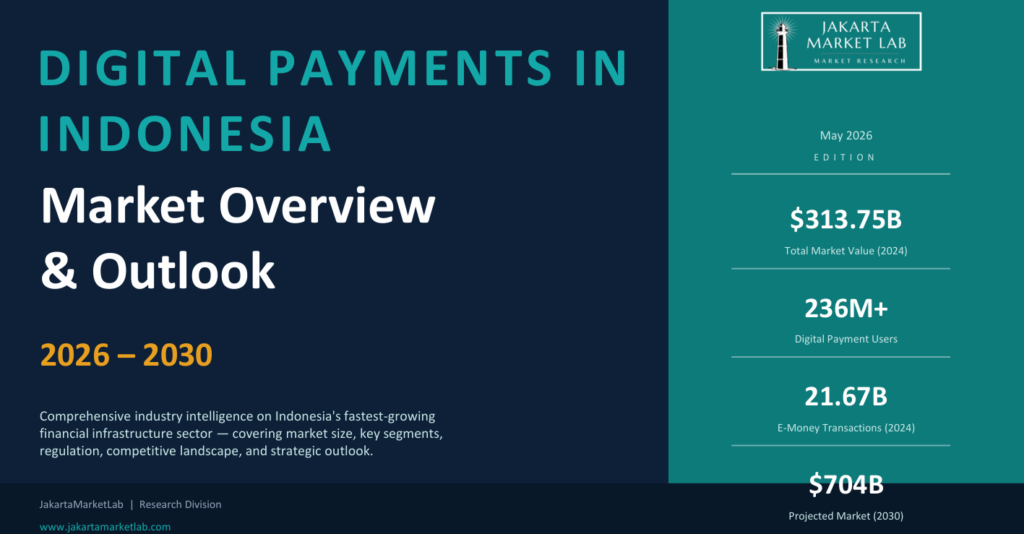
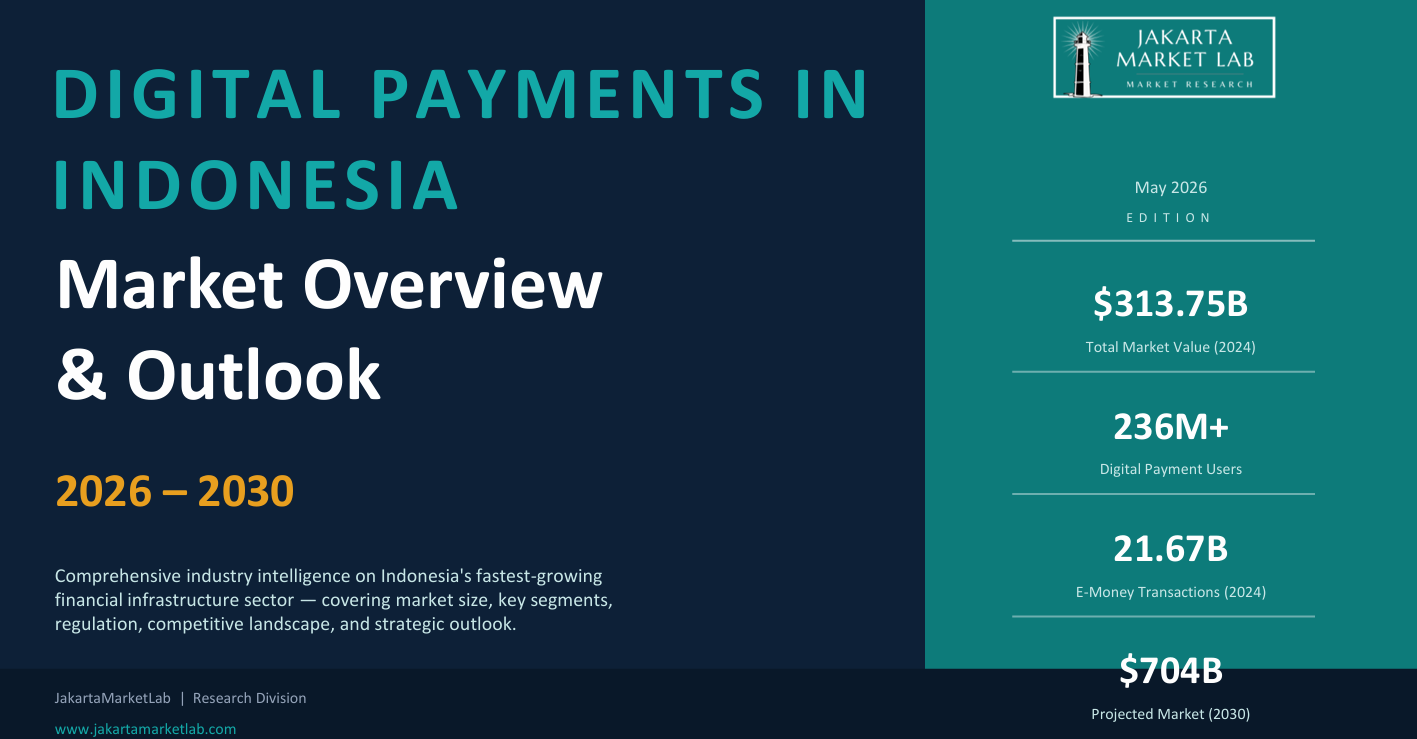
Digital Payments in Indonesia
Market Overview & Outlook 2026 – 2030
Publisher: JakartaMarketLab |
Geography: Republic of Indonesia |
Forecast Period: 2026 – 2030 |
Pages: 25 Slides |
Published: May 2026
Market Overview
Indonesia’s Digital Payments Ecosystem: A Decade of Structural Transformation
Indonesia’s digital payments sector has undergone one of the most rapid structural transformations in Southeast Asian financial history. Accelerated profoundly by the COVID-19 pandemic and sustained by a powerful confluence of macroeconomic, demographic, and policy tailwinds, the market’s total transaction value surged from approximately USD 101 billion in 2018 to an estimated USD 313.75 billion in 2024 — representing a compound annual growth rate of approximately 20.8% over six years. This trajectory places Indonesia firmly among the top digital payments markets globally in absolute value terms, outpacing major economies in the region by a substantial margin.
Within Southeast Asia, Indonesia commands the largest digital payments transaction pool, accounting for roughly 43% of the region’s total — more than triple the transaction volume of Vietnam, the region’s second-largest market. This dominance is underpinned by a population of 278 million, a rapidly expanding middle class, deepening smartphone penetration now exceeding 70%, and the emergence of a vibrant fintech ecosystem anchored by super-app platforms that have fundamentally redefined how Indonesian consumers engage with money. Bank Indonesia’s pivotal infrastructure initiatives — particularly the QRIS unified QR payment standard deployed across 55+ million merchant touchpoints, and BI-FAST enabling instant 24/7 interbank transfers — have provided the rails upon which this market is being built.
The structural shift from cash to digital is particularly striking when viewed through the lens of point-of-sale payment behavior. Cash’s share of in-store POS transactions declined from 79% in 2017 to 38% in 2024, with forward projections pointing to a mere 19% by 2030. Mobile wallets and account-to-account transfers have emerged as the primary beneficiaries of this secular shift, collectively accounting for over 40% of POS payments in 2024. With 373 million projected users by 2030 — equivalent to virtually every adult Indonesian — the market is entering a phase of deepening monetization and value extraction, rather than pure user acquisition. The competitive battleground is no longer about signing up new users; it is about converting payment relationships into full-spectrum financial service ecosystems.
“Indonesia’s digital payments market is no longer a growth story — it is a monetization story. The next phase belongs to operators who convert 236 million payment users into borrowers, investors, and insurance holders.”
— JakartaMarketLab Research Division, May 2026
Market Sizing
A Multi-Segment Market Approaching a Quarter-Trillion Dollar Inflection
The Indonesian digital payments market is structurally diverse, spanning five principal instrument categories: e-wallets and mobile wallets, ATM and debit card transfers, credit card payments, e-money (both chip-based and server-based instruments), and online banking. Each segment exhibits a distinct growth trajectory, competitive dynamic, and user behavioral profile — creating a layered market where opportunity varies significantly depending on where an operator or investor is positioned in the value chain.
At the broadest level, the total market — measured as Gross Transaction Value across all digital instruments — reached USD 313.75 billion in 2024, on a trajectory to reach USD 704 billion by 2030 under our base-case scenario. This growth is anchored by two engine segments: digital commerce payments and mobile POS payments, which together represent the full spectrum of how Indonesian consumers spend digitally — online and in-store. The e-money segment alone recorded 21.67 billion transactions in 2024, a 66-fold increase from 2017, reflecting the explosive adoption of server-based instruments tied to the e-wallet ecosystem.
Full Segment Breakdown Available in the Report
The full report contains year-by-year transaction values, volume data, and penetration rates for all five payment instrument categories (E-Wallet, ATM/Debit, Credit Card, E-Money, Online Banking) from 2017 through 2030E — including channel splits by online vs. offline, and consumer vs. merchant end-use.
Consumer Trends
Six Mega-Trends Reshaping How 278 Million Indonesians Pay
The forces reshaping Indonesia’s digital payments landscape extend well beyond simple technology adoption. Structural demographic shifts, regulatory architecture, behavioral evolution, and macroeconomic dynamics are converging to produce a payment environment unlike anything seen in the country’s financial history. Our research identifies six mega-trends that will define competitive positioning through 2030.
Smartphone Proliferation & 5G Rollout
Indonesia’s smartphone user base is projected to reach 235 million by 2028. 5G commercial deployment will reach 12 major cities by 2026, enabling ultra-low latency payment experiences critical for contactless, IoT-embedded, and augmented commerce transactions — opening entirely new payment surface areas beyond the mobile screen.
Gen Z & Millennial Digital-Native Demand
With a median age of 29.3 years and Gen Z representing 27% of the population, Indonesia’s youth cohort is bypassing traditional banking entirely. By 2030, this generation will represent 60% of the workforce — making digital-native payment behavior not an emerging trend but the dominant economic reality shaping product and infrastructure investment decisions.
Get Full Report to Access Trends #3, #4, #5, and #6
Additional mega-trends are in the full report.
Competitive Landscape
A Hyper-Concentrated Arena Dominated by Super-App Ecosystems
Indonesia’s digital payments competitive landscape is defined by extraordinary market concentration, intense rivalry, and the strategic centrality of super-app ecosystems. The top four e-wallet players collectively command over 95% of consumer adoption, creating a competitive environment where new entrants face not just product competition but deep ecosystem lock-in reinforced by loyalty programs, embedded BNPL products, and habitual daily-use super-app integrations.
GoPay, embedded within the Gojek super-app ecosystem serving ride-hailing, food delivery, and logistics, has achieved the highest consumer adoption in the market. Its strategic evolution beyond payment MDR toward higher-margin financial services — including BNPL products and digital savings accounts — is representative of the industry’s broader monetization trajectory. Dana, operating as a joint venture with Ant Group’s Alipay, brings world-class fintech engineering and international merchant network access, differentiating through its B2B merchant services and best-in-class security reputation. SeaBank — Sea Group’s fully licensed digital bank — has achieved remarkable Gen Z penetration and is executing a cross-monetization strategy using Shopee’s dominant e-commerce position as a captive payment audience funnel into broader banking products.
The competitive intensity is assessed as Very High by JakartaMarketLab’s Porter’s Five Forces analysis, driven by near-zero consumer switching costs across wallets, ongoing cashback and subsidy wars, and the strategic pressure of super-app platforms seeking to become the primary financial services relationship for their tens of millions of daily active users.
Full Competitive Intelligence Available in the Report
The full report includes individual company profiles for GoPay, OVO, Dana, ShopeePay, and SeaBank — covering key innovations, strategic outlook, monetization models, and a competitive benchmarking matrix. Porter’s Five Forces analysis and a full regulatory event timeline (2019–2030) are also included.
Outlook & Forecast
From $314 Billion to $704 Billion: Indonesia’s Digital Payments Road to 2030
JakartaMarketLab’s base-case triangulated projection estimates Indonesia’s digital payments market reaching USD 704 billion by 2030, driven by parallel expansion in digital commerce and mobile POS payments. The growth story is transitioning from user acquisition to frequency deepening and average transaction value expansion.
Five strategic imperatives will determine who wins in this market through 2030: the ability to monetize beyond the transaction fee into lending, insurance, and investment services; investment in rural and Tier 3–5 city penetration where the next 100 million digital payment users reside; embrace of Bank Indonesia’s SNAP open banking mandate as a growth catalyst rather than a compliance burden; prioritization of AI-driven cybersecurity as a brand trust asset; and preparation for the potential retail rollout of Bank Indonesia’s Digital Rupiah (Project Garuda) — a development that could fundamentally reshape the settlement infrastructure of the entire ecosystem.
Key risks to the base case include regulatory over-tightening, major cybersecurity incidents that erode consumer trust, and global macroeconomic headwinds dampening consumer spending. The report shows some possible scenarios.
“By 2030, Indonesia will have more digital payment users than the entire current population of the United States. This is not a fintech story — it is a story about the financial rewiring of the world’s fourth most populous nation.”
— JakartaMarketLab Research Division, May 2026
Report Contents
What the Full Report Includes
Executive Summary & Key Findings
Market size snapshot, strategic highlights, and 6 key findings at a glance
Regulatory Landscape (2019–2030)
Bank Indonesia mandates, OJK framework, SNAP standards, CBDC roadmap
Full Market Sizing (2017–2030E)
Total GTV, segment-level data, penetration rates, and user growth projections
Ecosystem Value Chain Analysis
Infrastructure to end-user mapping, monetization models across all layers
Porter’s Five Forces Analysis
Competitive intensity assessment, structural attractiveness scoring
6 Mega Trends & Market Drivers
Smartphone/5G, Gen Z demand, BNPL, government push, open banking, AI
Top 5 Company Profiles
GoPay, OVO, Dana, ShopeePay, SeaBank — strategy, innovations, benchmarking
Future Prospects 2026–2030
Bull/base/bear scenario analysis, 5 strategic imperatives for market participants
Now Available
Digital Payments in Indonesia: Market Overview & Outlook 2026–2030
Pages: 25 Slides
Geography: Indonesia (34 Provinces)
Base Year: 2024 | Forecast: 2026–2030
Segments: E-Wallet, ATM/Debit, Credit Card, E-Money, Online Banking, BNPL
Get full access to all data tables, segment breakdowns, company profiles, regulatory analysis, and the 2026–2030 forecast scenarios.
This article is a promotional summary of the full market research report published by JakartaMarketLab. Selected statistics are shown for indicative purposes only. Complete data and methodology are available in the full report. © 2026 JakartaMarketLab. All Rights Reserved
© 2026 JakartaMarketLab Market Intelligence | www.jakartamarketlab.com