
Industries & Markets | JakartaMarketLab Research Division
Indonesia Cigarettes Market
Market Overview & Outlook 2026 – 2030
A deep-dive analysis covering market dynamics, regulatory landscape, competitive positioning, and strategic outlook for Indonesia’s tobacco industry — the world’s third-largest smoker population and Southeast Asia’s dominant cigarette market.
Publisher: JakartaMarketLab |
Geography: Indonesia (34 Provinces) |
Forecast Period: 2026 – 2030 |
Pages: 45 Pages |
Published: May 2026
Market Overview
Volume Down, Value Up: Indonesia’s Cigarette Market Enters a New Structural Phase
Indonesia’s cigarette market is one of the most structurally complex and commercially significant tobacco markets anywhere in the world. With an estimated 62.8 million smokers — making it the world’s third-largest smoker population — and a deep cultural attachment to kretek, the uniquely Indonesian clove cigarette that accounts for over 98% of total retail volume, the market operates by rules that simply do not apply in any other country. It is also a market caught in a paradox that is becoming increasingly difficult to ignore: retail volume has contracted for two consecutive years, yet market value continues to expand at a healthy pace, driven by an aggressive excise-led pricing cycle that has reshaped the competitive dynamics of the entire industry.
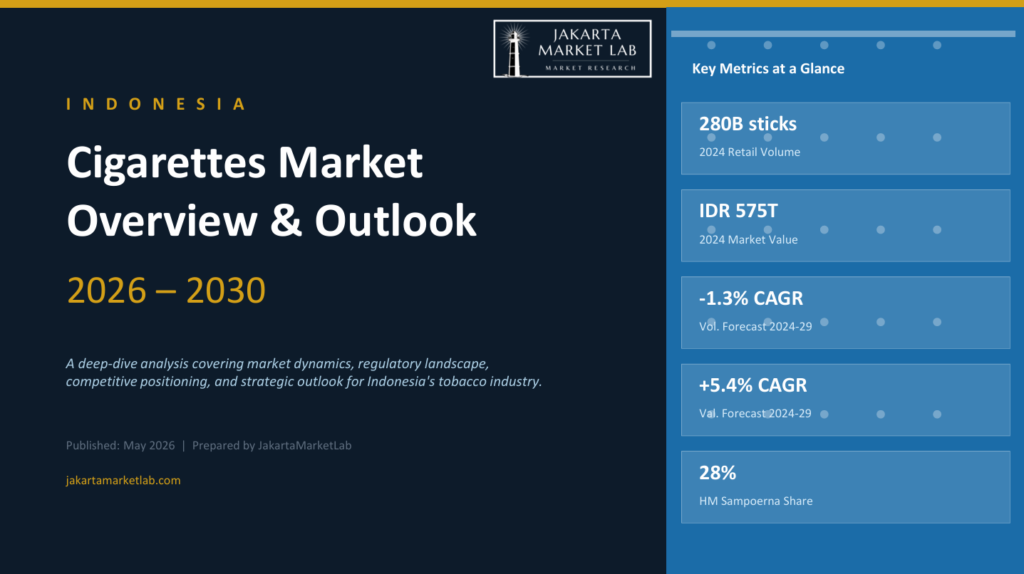
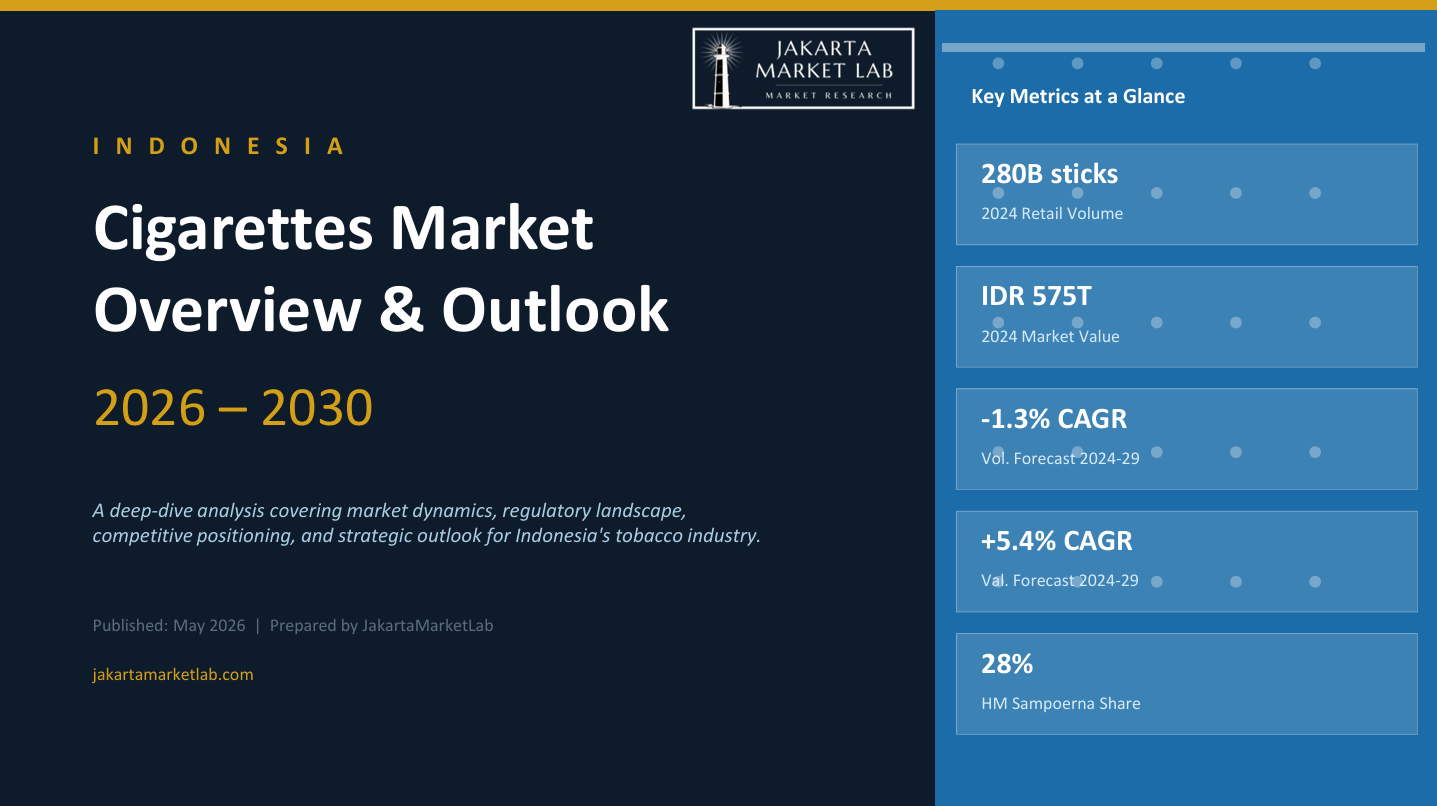
The total retail market stood at approximately 280 billion sticks in 2024 — down 1.0% year-on-year following a 0.9% decline in 2023 — while market value reached IDR 575 trillion, up 5.5% on the prior year. This volume-value divergence, which JakartaMarketLab projects to persist through 2030, is the defining structural feature of the Indonesian tobacco landscape today. Cumulative CHT (excise) increases of approximately 22% over 2023–2024 have simultaneously inflated market value, eroded consumer affordability in lower-income segments, accelerated downtrading into hand-rolled kretek (SKT), and widened the price gap that incentivizes illicit cigarette consumption — a gap that now accounts for an estimated 7–9% of total consumption volume, up from roughly 5% in 2019.
The competitive landscape has simultaneously undergone a dramatic reshuffling. HM Sampoerna, backed by Philip Morris International, has held the line at 28.4% volume share through portfolio diversification. Djarum — the Hartono family’s private powerhouse headquartered in Kudus — has executed the most aggressive share capture of any major player, rising from 13.5% in 2020 to 20.4% in 2024 by doubling down on economy hand-rolled kretek. Gudang Garam, once a near-peer to Sampoerna, has shed roughly 13 percentage points of share over the same period in what JakartaMarketLab characterizes as a structural decline rooted in brand ageing and strategic underinvestment in the economy segment.
“Indonesia’s cigarette market is not declining — it is transforming. Volume falls, but value rises. Mid-price hollows out, but economy and premium both gain. The brands that read this bifurcation correctly will build decade-long competitive advantages.”
— JakartaMarketLab Research Division, May 2026
Market Sizing
IDR 575 Trillion Today. IDR 746 Trillion by 2029. The Math Behind the Paradox.
The Indonesian cigarette market is measured across multiple dimensions — retail volume in billion sticks, market value in IDR trillion, and segmentation by price band, product format, blend, and distribution channel. Together, these dimensions paint a picture of a market that, while contracting in volume terms, remains exceptionally resilient in value and is projected to reach IDR 746 trillion by 2029, representing a 5.4% value CAGR from the 2024 base. This is driven almost entirely by excise-led price inflation, which pushes the average realized price per stick upward across all categories regardless of volume trends.
The most important structural trend within the market is the polarization of consumer demand across price bands. The mid-price segment — historically the heart of the Indonesian cigarette market — is being hollowed out as consumers either trade down into economy-tier hand-rolled kretek, attracted by dramatically lower prices afforded by SKT’s structural excise advantage, or remain anchored in premium SKM brands whose brand equity commands loyalty even at higher prices. The economy segment’s share of total volume has grown from 33.0% in 2019 to 34.7% in 2024, and is projected by JakartaMarketLab to reach 38.6% by 2029.
Full Segment Breakdown Available in the Report
The full report contains year-by-year volume and value data from 2019 through 2029F, segmented by price band (Economy/Mid/Premium), product blend (Kretek vs. White), format (SKM/SKT), flavour profile (Standard/Menthol/Capsule), pack size, and distribution channel. Brand-level volume share data for the top 10 brands (2021–2024) and the full CHT excise tiered rate table are also included.
Industry Mega Trends
Six Structural Forces Reshaping Indonesia’s Tobacco Market Through 2030
The forces reshaping this market extend well beyond the immediate excise cycle. JakartaMarketLab has identified six structural mega-trends that will define how manufacturers, distributors, and investors must position themselves to navigate the Indonesian tobacco market through the 2026–2030 horizon.
Volume-Value Divergence Entrenches
Indonesia is entering the same phase experienced by mature markets like Australia and the UK, where volume steadily declines while market value grows — driven by excise-led price inflation. JakartaMarketLab projects this divergence to persist through 2030, with value growing at approximately 5.4% CAGR despite a −1.3% volume CAGR. Manufacturers are adapting by shifting focus from volume share to value share and revenue-per-stick metrics as the primary performance benchmarks.
Economy SKT Segment Renaissance
Hand-rolled kretek (SKT) benefits from a structural excise advantage that amounts to a more than fivefold cost differential versus machine-made SKM at the top tiers — a gap that is politically protected due to SKT’s 580,000+ direct employment base in Central and East Java. This is driving major manufacturers to aggressively expand SKT portfolios, and JakartaMarketLab projects the segment to grow from approximately 22% of total volume in 2024 to 28% by 2029 — the sharpest structural shift in the market’s product mix in a decade.
Get Full Report to Access Trends #3, #4, #5, and #6
Additional mega-trends are available in the complete report.
Competitive Landscape
A Market in Competitive Flux: One Leader Holding, One Challenger Rising, One Giant Retreating
The competitive landscape of Indonesia’s cigarette market has been more dynamic in the past four years than at any point in the preceding decade, and the forces driving that dynamism — excise-induced consumer downtrading, the SKT structural advantage, and the emergence of Korean challenger KT&G — show no signs of abating. HM Sampoerna (backed by Philip Morris International) retains its leadership position with 28.4% volume share, built on the enduring equity of the A Mild franchise and an increasingly astute pivot toward economy SKT through its Sampoerna Kretek and Dji Sam Soe brands. Its parent company’s dual-track strategy of maintaining cigarette volume while investing in IQOS heated tobacco products positions Sampoerna uniquely for both the near-term competitive battle and the longer-term alternative nicotine transition.
Djarum is the standout strategic story of 2020–2024. Rising from 13.5% to 20.4% market share in four years — a gain of 6.9 percentage points — Djarum’s willingness to fully commit to the economy SKT opportunity through Djarum Coklat and regional SKT acquisitions, while simultaneously defending premium share through Djarum Super, represents the ideal strategic posture for the market environment ahead. The Hartono family’s long-term private ownership enables patient capital allocation, a structural advantage over publicly-listed peers. Meanwhile, Gudang Garam — once a near-peer to Sampoerna — has experienced the most dramatic decline in the market, shedding approximately 13 percentage points of share since 2020. Its legacy portfolio is skewed toward premium SKM products that face the highest excise burdens, and the company has made insufficient investment in either economy SKT or new format development.
The most disruptive new force in the market is South Korean conglomerate KT&G, whose Esse brand has grown from 3.1% to 5.1% volume share in four years by cracking a demographic that incumbents had largely neglected: young urban women. Esse’s slim format, menthol positioning, and aesthetically differentiated branding have created a new consumption occasion in the kretek-dominated market — and KT&G’s 2024 launch of Climax signals ambition to move beyond a single-brand story into broader kretek format competition.
Full Company Profiles & Brand Share Data in the Report
The full report includes deep-dive company profiles for HM Sampoerna, Djarum, Gudang Garam, KT&G, and Nojorono Tobacco — covering financial estimates, brand portfolio analysis, market share trends (2020–2024), and strategic assessments from JakartaMarketLab’s research team. Brand-level volume share data for the top 10 brands and Porter’s Five Forces analysis are included.
Outlook & Forecast
IDR 746 Trillion by 2029 — The Base Case for a Market That Defies Simple Narratives
JakartaMarketLab’s base-case forecast projects the Indonesian cigarette market reaching IDR 746 trillion in value by 2029, representing a 5.4% CAGR from the 2024 base — driven by sustained excise-led price inflation rather than volume growth. Volume is expected to decline to approximately 263 billion sticks by 2029, a −1.3% CAGR, as the combination of excise affordability pressure, the minimum smoking age increase to 21 years, and growing substitution from e-vapor and heated tobacco products apply steady downward pressure on legal cigarette consumption. This base case is assigned a 60% probability weighting by JakartaMarketLab, with a 20% bear case (IDR 710T / 255B sticks, driven by aggressive CHT hikes and accelerating illicit trade) and a 20% bull case (IDR 785T / 275B sticks, driven by moderate CHT increases and slower-than-expected vapor substitution).
The single most important variable in any Indonesian tobacco market outlook is illicit trade. JakartaMarketLab estimates illicit cigarettes currently account for 7–9% of total consumption — up from approximately 5% in 2019 — representing some 25 billion sticks annually and IDR 12–15 trillion in lost annual excise revenue. Every 1% shift in illicit market share transfers approximately 2.8–3.0 billion sticks of demand from the legal market, making illicit trade dynamics the primary swing variable for both volume forecasts and regulatory policy over the 2026–2030 period. Investors and analysts should monitor DJBC monthly excise revenue data as a real-time leading indicator of illicit trade acceleration.
“The next phase of competition in Indonesian tobacco will not be won in television commercials or minimarket shelf space — it will be won in Tier 2–3 cities and rural markets of Sumatra, Kalimantan, and Sulawesi, where the economy SKT consumer lives and the illicit trade problem is most acute.”
— JakartaMarketLab Research Division, May 2026
Report Contents
What the Full Report Includes
Executive Summary & Key Findings
Volume-value paradox narrative, competitive reshuffling highlights, economy segment dynamics
Industry Regulations & CHT Structure
Full 2024 CHT rate table, PP No. 28/2024 provisions, regulatory timeline 2023–2030
Market Overview (2019–2029F)
Volume & value trends, price band segmentation, blend & format mix, distribution channels, illicit trade analysis, smoking prevalence demographics
Industry Value Chain Analysis
Leaf procurement, clove sourcing, manufacturing, excise pass-through, distribution, raw material economics & labor dependency
Porter’s Five Forces & 6 Mega Trends
Competitive intensity, market drivers & restraints, structural transformation forces through 2030
Market Segmentation & Brand Shares
Company volume shares 2020–2024, top 10 brand-level share data, price band & format mix forecasts to 2029
Top 5 Company Profiles
HM Sampoerna, Djarum, Gudang Garam, KT&G, Nojorono — financials, brands, strategy & JML assessments
Future Prospects & Strategic Outlook
Bull/base/bear scenario analysis (2026–2030) plus 4 strategic recommendations for manufacturers and investors
Now Available
Indonesia Cigarettes Market: Overview & Outlook 2026–2030
Pages: 45 Pages | 30+ Charts
Geography: Indonesia (All 34 Provinces)
Forecast: 2026–2030
Companies: HM Sampoerna, Djarum, Gudang Garam, KT&G, Nojorono
Get full access to all volume and value data tables, brand share analysis, regulatory deep-dives, value chain economics, and the 2026–2030 scenario forecasts.
This article is a promotional summary of the full market research report published by JakartaMarketLab. Selected statistics are shown for indicative purposes only. Complete data and methodology are available in the full report. © 2026 JakartaMarketLab. All Rights Reserved.
© 2026 JakartaMarketLab Market Intelligence | www.jakartamarketlab.com