
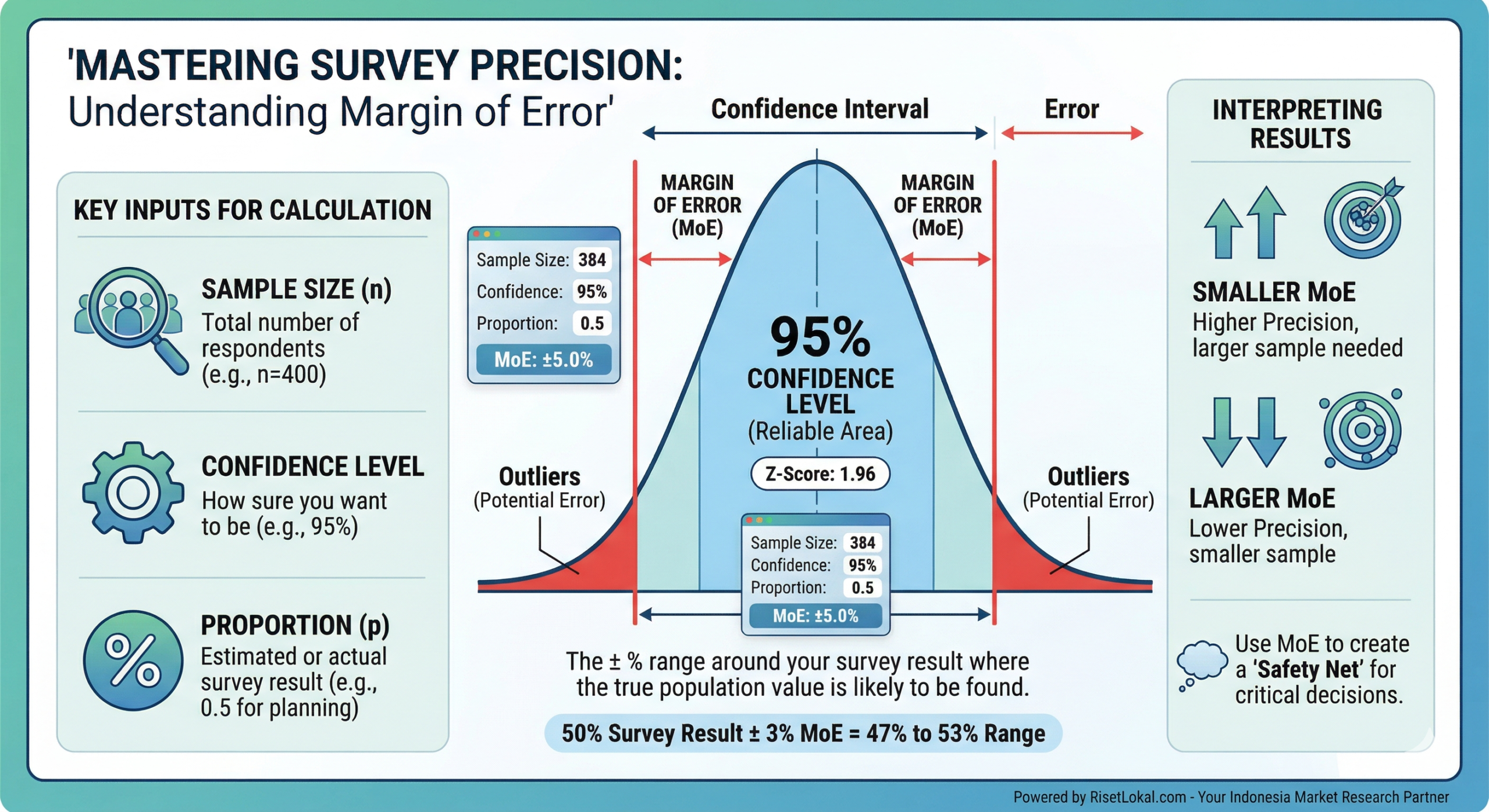
When you read a political poll or a market research report that states a brand is favored by 60% of the population, there is always a silent “give or take” attached to that number. In the world of statistics and professional market research, this “give or take” is known as the Margin of Error (MoE).
Understanding this concept is the difference between making a reckless business gamble and making an informed, data-driven decision. Whether you are a student, a researcher, or a business owner in Indonesia looking to scale, mastering the Margin of Error is essential.
1. Introduction: The Theory Behind Margin of Error
At its core, the Margin of Error is a statistic expressing the amount of random sampling error in the results of a survey. The larger the margin of error, the less confidence one should have that a poll result would reflect the result of a survey of the entire population.
The Mechanics of the Formula
The calculator embedded below utilizes the standard statistical formula for a population proportion. As shown in the tool’s logic:
Where:
- (Z-score): This corresponds to your Confidence Level. It tells us how sure we want to be. A 95% confidence level (Z = 1.96) is the gold standard in social science and business research.
- p (Proportion): This represents the sample proportion. If you don’t know the result yet, researchers use 0.5 (50%) because it is the most “conservative” estimate, yielding the largest possible margin of error.
- n (Sample Size): This is the total number of completed responses you have collected.
The relationship is inverse: as your sample size ($n$) increases, your Margin of Error decreases. This is why nationwide polls often aim for 1,000+ respondents to achieve a margin of error around $\pm 3\%$.
2. Practical Real-Life Use Case: Launching a New Beverage in Jakarta
Imagine you are a marketing manager planning to launch a new “Gula Aren” Latte in Jakarta. You want to know if people will actually buy it. You can’t ask all 10 million residents, so you survey 400 people.
- The Result: 70% of your respondents say they would buy the latte.
- The Question: Is that 70% “real,” or did you just happen to ask a group of people who love sugar?
By using the Margin of Error Calculator, you input your sample size of 400 and a 95% confidence level. The calculator would show a Margin of Error of approximately.
The Real-World Interpretation: You can be 95% confident that if you surveyed every single person in Jakarta, between 65.1% and 74.9% would buy your drink. This range is your “safety net” for financial forecasting.
3. How to Use the RisetLokal Margin of Error Calculator
The tool provided above is designed for high-speed precision. Here is a step-by-step guide to using the interface effectively:
📏 Margin of Error Calculator
✅ Margin of Error: ±%
Where Z = Z-score, p = proportion (0.5 default), n = sample size
How to read: Your results are accurate within this ±% range at the chosen confidence level. Lower margin = more precise, but requires larger sample. Example: ±5% means “45-55%” if you got 50%.
Need Indonesia market research reports? Visit risetlokal.com
For professional market research services in Indonesia, contact risetlokal.com
Step 1: Input Sample Size (n)
In the field labeled Sample Size (n), enter the number of people who actually completed your survey. Do not enter the number of people you invited—only those who provided usable data.
Step 2: Select Confidence Level
The dropdown menu offers three standard choices:
- 90%: Good for quick, informal internal testing.
- 95%: The industry standard for professional market research.
- 99%: Reserved for critical scenarios where the cost of being wrong is extremely high (e.g., medical trials).
Step 3: Set Expected Proportion (p)
If you have already conducted the survey, enter the decimal version of your result (e.g., 0.6 for 60%). If you are planning a survey and want to see the “worst-case” margin of error, leave this at 0.5.
Step 4: Calculate
Click the “Calculate Margin of Error” button. The script will instantly process the Z-score logic and display your result in the red-bordered result box.
4. Interpretation: Turning Percentages into Strategy
Once the calculator gives you a number—how do you actually use that in a board meeting or a thesis?
A. The “Confidence Interval”
The Margin of Error defines your Confidence Interval. If your survey says 50% of people prefer Brand A, and your MoE is 3%, your interval is 47% to 53%. If a competitor has 48%, you are in a “statistical dead heat,” meaning you cannot definitively say you are winning.
B. Precision vs. Cost
If your Margin of Error is too high, your data is “noisy” and potentially unreliable for big investments. To lower the margin, you must increase your sample size. However, doubling your precision (cutting the error in half) requires quadrupling your sample size.
C. The Law of Diminishing Returns
Notice that increasing a sample from 100 to 500 drastically reduces error. However, increasing from 2,000 to 2,500 offers very little improvement. Professional researchers at RisetLokal.com use this logic to help clients find the “sweet spot” where they get valid data without overspending on unnecessary respondents.
5. Professional Market Research in Indonesia
While online calculators are excellent for quick checks, large-scale data collection in a country as diverse as Indonesia requires local expertise. Factors like geographic distribution across 17,000 islands, socio-economic status (SES) stratification, and cultural nuances in survey responses can skew your results far beyond what a simple formula can predict.
Expert Endorsement:
Need deeper insights into the Indonesian market? RisetLokal.com provides comprehensive market research services across all provinces. From determining the right sample size to executing field surveys and providing expert data interpretation, they are your primary partner for growth in the Archipelago.
For professional inquiries, visit RisetLokal.com/contact.
6. Summary and Final Tips
The Margin of Error is not a sign of a “bad” survey; it is a transparent measure of a survey’s reliability. By using the calculator embedded in this article, you are taking the first step toward scientific literacy in business.
- Always report your MoE alongside your findings to maintain credibility.
- Use 95% confidence unless you have a specific reason to do otherwise.
- Remember the proportion: If a result is very lopsided (e.g., 95% vs 5%), your margin of error actually shrinks, making your data more precise.