Market Research Report: EV Battery Industry in South Korea 2026-2030

Industries & Markets | JakartaMarketLab Research Division
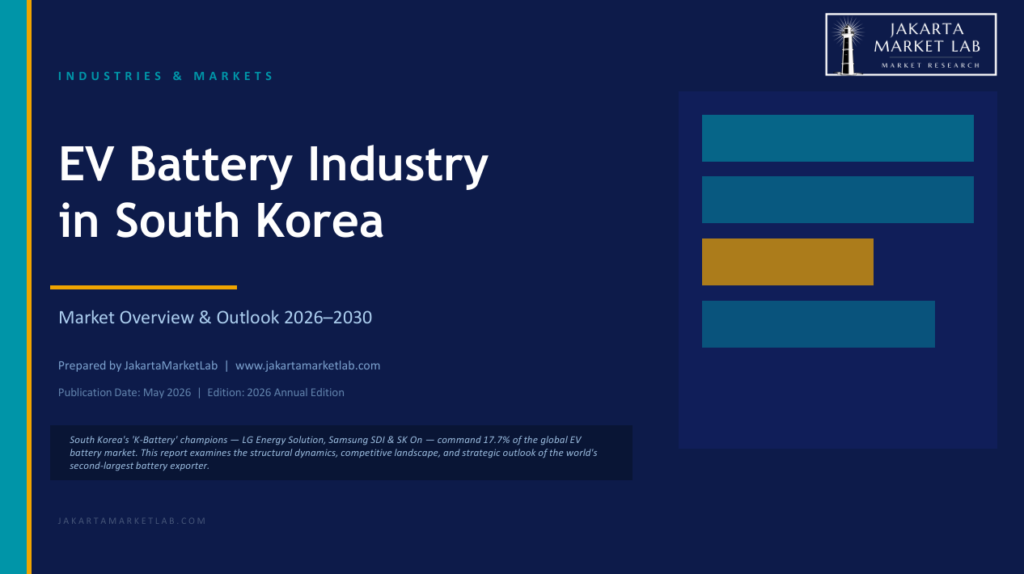
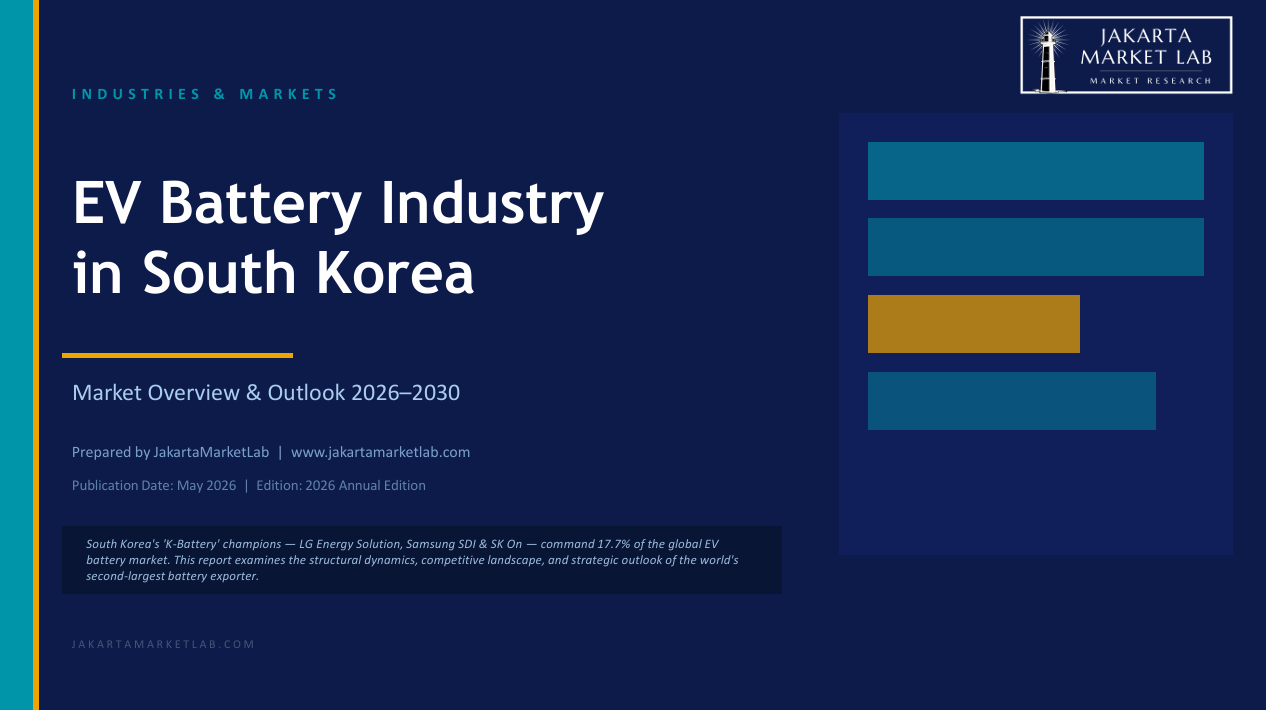
EV Battery Industry in South Korea
Market Overview & Outlook 2026 – 2030
South Korea’s ‘K-Battery’ champions — LG Energy Solution, Samsung SDI & SK On — command 17.7% of the global EV battery market. This report examines the structural dynamics, competitive landscape, and strategic outlook of the world’s second-largest battery exporter.
Publisher: JakartaMarketLab |
Geography: South Korea (+ Global Export Context) |
Forecast Period: 2026 – 2030 |
Pages: 27 Slides |
Published: May 2026
Market Overview
K-Battery at the Crossroads: A Reset Year Preceding a Strategic Comeback
South Korea’s EV battery industry occupies a singular position in the global energy transition. The country’s three major cell manufacturers — LG Energy Solution (LGES), Samsung SDI, and SK On — collectively command 17.7% of the global EV battery market as of early 2025, making South Korea the world’s second-largest battery exporter behind China. With combined 2024 revenues of USD 40.4 billion and a decade-long track record of supplying the world’s leading automotive OEMs, the K-Battery ecosystem has become indispensable to the electrification strategies of General Motors, Volkswagen, BMW, Ford, Hyundai-Kia, and Stellantis — a list that reads like a who’s who of global vehicle manufacturing.
Yet 2024 was a year of reckoning. All three Korean battery majors experienced synchronized revenue and volume declines, driven primarily by EV demand deceleration in the European and North American markets, compounded by aggressive customer inventory destocking. Combined GWh shipments fell from 235 GWh in 2023 to 189 GWh in 2024 — a 19.6% decline that erased two years of hard-won volume gains. LG Energy Solution’s revenue contracted 24% year-on-year to KRW 25.62 trillion, while Samsung SDI dropped 23% and SK On — still carrying the weight of cumulative operating losses since its 2021 spin-off — posted a widening annual loss despite modest revenue growth. JakartaMarketLab interprets this contraction as a market reset driven by inventory dynamics, not structural demand destruction. The underlying drivers of battery demand — global EV penetration curves, policy mandates, and the energy storage buildout — remain intact and are expected to reassert themselves from 2026 onward.
Simultaneously, the industry is navigating a profound geopolitical restructuring of global supply chains. The US Inflation Reduction Act’s Section 45X manufacturing credits — providing USD 35 per kWh for cells produced in North America — have positioned Korean OEMs as the primary beneficiaries of the world’s most consequential industrial policy for clean energy manufacturing. Korean companies have collectively committed over USD 50 billion in North American gigafactory investments through 2030, spanning joint ventures with GM, Stellantis, Ford, and Hyundai. This investment footprint is not merely a compliance strategy; it is the foundation of a sustainable competitive advantage in the world’s second-largest EV market.
“The 2024 volume decline is not the story. The story is that Korean OEMs are building the North American battery infrastructure that will supply the next decade of EV production — and the IRA is paying for a significant portion of it.”
— JakartaMarketLab Research Division, May 2026
Market Sizing
From 189 GWh to 415 GWh: The Road Map to 2030
The Korean EV battery market is measured across multiple dimensions — GWh shipment volume, corporate revenue in KRW, and USD export value through the Korea Customs Service trade channel. Each tells a complementary story. At the trade level, South Korea exported USD 5.42 billion worth of lithium-ion batteries in 2024, with the United States representing the single largest destination at USD 2.99 billion. This export figure, while down 25% from the 2023 peak of USD 7.27 billion, reflects the temporary inventory correction rather than a loss of market positioning.
The market is segmented across multiple battery types, chemistries, and end-use applications — automotive EV (passenger and commercial), energy storage systems (ESS), and portable electronics. Korean OEMs currently derive approximately 58% of revenue from automotive EV applications and 22% from ESS — a ratio that JakartaMarketLab projects will shift materially toward ESS as the global grid-scale storage market accelerates. JML’s base-case scenario projects combined K-Battery OEM shipments recovering to 415 GWh by 2030, representing a 14.9% CAGR from the 2024 trough.
Full Segment Breakdown Available in the Report
The full report contains year-by-year GWh shipment data and revenue figures for all three Korean OEMs (2015–2024 actuals), segmented by battery chemistry (NMC, NCMA, NCA, LFP), by application (Automotive EV, ESS, Portable Electronics, Commercial Vehicle), and by geography (Korea domestic, USA, EU, APAC export flows). Bull/base/bear scenario projections through 2030 with full assumptions are included.
Industry Mega Trends
Six Forces Reshaping the Global EV Battery Value Chain Through 2030
The competitive and technological landscape of the EV battery industry is undergoing transformations that extend well beyond cyclical demand patterns. JakartaMarketLab has identified six structural mega-trends that will define the strategic positioning of Korean OEMs and their supply chain partners over the 2026–2030 horizon.
Battery Chemistry Evolution
The industry is transitioning from conventional NMC 622/811 formulations to higher-density NCMA chemistries with nickel content exceeding 90%. Korean OEMs are leading the charge in all-solid-state battery R&D — Samsung SDI targets commercial ASSB production by 2027 at 900 Wh/L energy density, a 35% improvement over current generation cells. Pack costs are forecast to drop below USD 80/kWh by 2027, enabling EV-ICE price parity in key vehicle segments.
Geopolitical Supply Chain Realignment
The IRA and FEOC rules are fundamentally re-routing global battery supply chains away from Chinese suppliers. Korean OEMs have committed over USD 56 billion in North American manufacturing — including LGES-GM’s Ultium Cells joint venture (140 GWh across 3 US plants), SK On-Ford’s BlueOval SK (86 GWh in Kentucky), and SDI-Stellantis (33 GWh in Indiana). Simultaneously, Korea is building raw material independence through investments in Indonesian nickel, Australian lithium, and Moroccan phosphate resources.
Get Full Report to Access Trends #3, #4, #5, and #6
Additional mega-trends are in the complete report.
Competitive Landscape
Three Giants Under Pressure — and the Materials Players Defining Their Future
The Korean EV battery competitive landscape is defined by three cell-level champions and a critical ecosystem of materials suppliers whose fortunes are deeply intertwined. LG Energy Solution retains structural market leadership as the world’s third-largest battery maker by GWh shipments, supported by one of the most diversified OEM customer portfolios in the industry — spanning GM, Stellantis, Volkswagen, Hyundai-Kia, and a growing Tesla relationship through its 4680-format cylindrical cell program. Its R&D expenditure in 2024 reached KRW 1,088 billion, underpinning ongoing advances in NCMA chemistry, solid-state technology, and ESS applications.
Samsung SDI has positioned itself as the premium-segment specialist, supplying BMW, Rivian, Volkswagen Group, and Stellantis with high-energy-density prismatic and cylindrical cells. The company’s all-solid-state battery program — backed by the largest ASSB patent portfolio outside Toyota at over 390 patents — represents perhaps the most consequential technology bet in the Korean battery industry. Record R&D spending of KRW 1,297 billion in 2024 signals unwavering commitment even as short-term profitability has contracted sharply under pricing pressure. The third major player, SK On, faces the most complex near-term challenge: post-spin-off losses that have now accumulated to KRW 3.6 trillion, a volume collapse tied to its concentrated exposure to Ford’s F-150 Lightning program, and the challenge of funding USD 16 billion in committed North American capacity additions while restoring financial credibility with investors.
Behind the cell makers, materials suppliers EcoPro BM and Posco Future M play critical and often under-appreciated roles. Korea holds roughly 13.3% of the global cathode active materials market — its strongest component position — while remaining structurally dependent on China for anodes (where Chinese producers control over 88% of global supply). Porter’s Five Forces analysis of the industry indicates High supplier bargaining power due to concentrated raw material sourcing, High buyer power as automotive OEMs actively dual-source to manage dependency, and Medium-Low threat of new entrants given the extreme capital requirements of gigafactory construction (USD 2–3 billion for a 30 GWh facility).
Full Company Profiles & Competitive Benchmarking in the Report
The full report includes detailed company profiles for LG Energy Solution, Samsung SDI, SK On, EcoPro BM, and Posco Future M — covering revenue and operating profit histories (2015–2024), R&D pipelines, OEM customer relationships, production site maps, and strategic innovation roadmaps. A full competitive benchmarking matrix and Porter’s Five Forces analysis are also included.
Outlook & Forecast
From 189 GWh to 415 GWh by 2030 — If the Conditions Hold
JakartaMarketLab’s base-case projection for the combined Korean K-Battery OEM GWh shipment volume targets 415 GWh by 2030, representing a 14.9% compound annual growth rate from the 2024 base. This recovery trajectory is premised on moderate EV demand recovery in the EU and USA markets beginning in 2026, continued IRA manufacturing tax credits (Section 45X) sustaining North American gigafactory economics, and the absence of major supply chain disruptions. A bull case — premised on strong IRA tailwinds, accelerated solid-state battery commercialisation, and Chinese competitors being constrained in Western markets by the FEOC rule — projects 530 GWh by 2030 at a 22.1% CAGR. A bear case, reflecting IRA credit rollback risk, sustained EV demand sluggishness, and Chinese LFP penetration of the US mid-segment, yields 302 GWh at a more modest 8.1% CAGR.
Four strategic imperatives will determine how Korean OEMs navigate this landscape through 2030. First, the profitability trajectory of SK On must be watched closely — a failure to reach breakeven by 2026 would put USD 16 billion in committed North American capex under serious investor scrutiny. Second, the US IRA’s Section 45X credits represent the single most powerful financial lever in the industry, and any political rollback represents an outsized downside risk. Third, Korea’s 85% import dependency on Chinese-sourced lithium-ion batteries for domestic ESS and electronics creates a structural vulnerability that regulators are beginning to scrutinize — a policy response before 2027 appears likely. Fourth, the commercialisation timeline for all-solid-state batteries at Samsung SDI and LGES — targeting 2027–2028 — represents what could be a generational technology inflection point for the premium EV segment.
“Korean OEMs are not losing the EV battery war. They are repositioning it — moving from a global commodity race to a technology-differentiated, policy-anchored, North American supply chain strategy that Chinese rivals cannot easily replicate.”
— JakartaMarketLab Research Division, May 2026
Report Contents
What the Full Report Includes
Executive Summary & Key Findings
6 critical data points, strategic imperatives, and the 2024 reset narrative
Regulatory Landscape (2022–2030)
K-Battery New Deal, IRA, EU Battery Regulation, FEOC Rule, Korea ZEV mandates
Market Overview & Value Chain
Trade balance data (2015–2024), green vehicle registrations, full ecosystem mapping
Porter’s Five Forces & 6 Mega Trends
Structural competitive intensity analysis and macro transformation drivers
Segmentation & Global Market Share
By chemistry (NMC/NCMA/NCA/LFP), application, and company vs. global peers
Market Drivers & Restraints
IRA tailwinds, ESS diversification, ASSB moat — vs. Chinese LFP threat, SK On losses
5 Company Profiles (with Financials)
LGES, Samsung SDI, SK On, EcoPro BM, Posco Future M — with DART-sourced data
Future Outlook 2026–2030
Bull/base/bear GWh scenarios, 4 strategic imperatives for investors & stakeholders
Now Available
EV Battery Industry in South Korea: Market Overview & Outlook 2026–2030
Pages: 27 Slides | 30+ Data Charts
Geography: South Korea + Global Context
Forecast: 2026–2030
Companies: LGES, Samsung SDI, SK On, EcoPro, Posco Future M
Get full access to all GWh data, financial profiles, regulatory analysis, chemistry segmentation, and 2026–2030 scenario forecasts.
This article is a promotional summary of the full market research report published by JakartaMarketLab. Selected statistics are shown for indicative purposes only. Complete data and methodology are available in the full report. © 2026 JakartaMarketLab. All Rights Reserved.
© 2026 JakartaMarketLab Market Intelligence | www.jakartamarketlab.com