10/18 Market Research Report: Air Conditioners Industry in Indonesia
Market Research Report | RisetLokal Research Desk
Air Conditioners Industry in Indonesia
Market Size, Product Mix, Prices, Channels, Local Manufacturing, Regulation & Competitive Review (2022–2025)
How Indonesia’s room air conditioner market works today: how many units it sells, what they cost, who makes them, where they are bought, and which rules set the bar for efficiency.
01 · Executive Summary
A big unit market with a small installed base
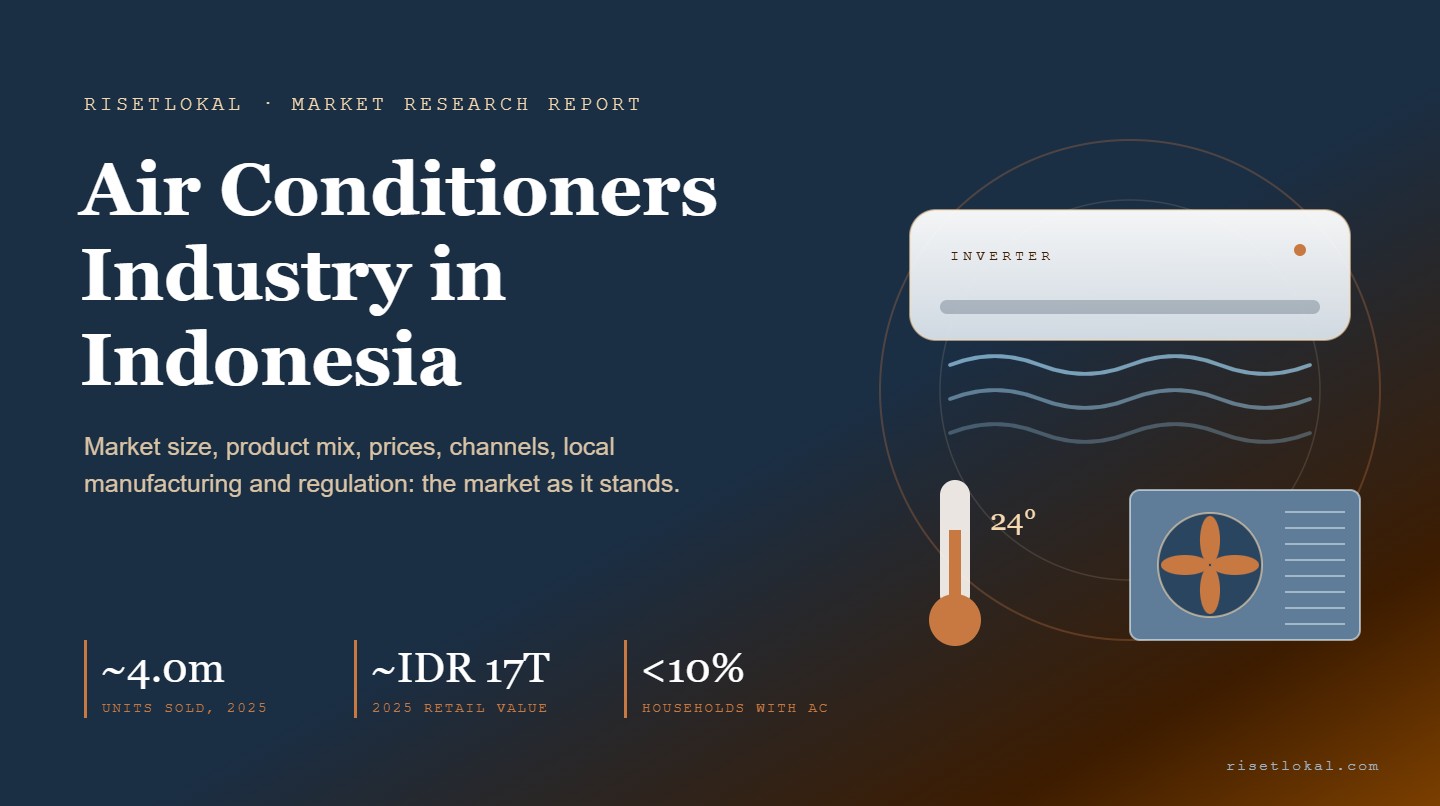
Indonesia sold roughly 4.0 million room air conditioners through retail channels in 2025, worth around IDR 17 trillion (about US$1 billion) at shelf prices. By unit count that puts it among the largest AC markets in Southeast Asia. Yet fewer than one household in ten owns an air conditioner. Most of the country still cools itself with fans, open windows and shade.
That gap explains much of what happens in the market. Sales swing with the weather and with household budgets, because for most families an AC is still a considered, once-in-several-years purchase. After two years of growth above 10%, unit sales rose only about 1% in 2025, a year with heavy rain and few days above 30°C. Value still grew about 6%, as shoppers paid more per unit for inverters and extra features.
Four facts frame the market today:
- It is a split-unit market. Wall-mounted split ACs make up about 98% of units. Portable units are small but grew 14% in 2025.
- Fixed-speed units still dominate. Inverters, which save power, are still under 20% of sales, even though their price premium has shrunk to a few hundred thousand rupiah at the entry level.
- Leadership is thin. Daikin and Sharp each hold about 17% of volume. Gree is third, and about two-thirds of the market is split among a dozen or more brands.
- Manufacturing is coming home. Daikin, LG and Sharp have opened AC plants in West Java since 2023. Daikin and LG alone have announced capacity of about 3.3 million units a year.
02 · Scope & Method
What we measured
This report covers room air conditioners sold to consumers through retail channels in Indonesia: wall-mounted split units (fixed-speed and inverter), portable units and window units. Large commercial systems such as VRF, ducted units and chillers, which are sold through project contracts, are outside the market size. Many small offices, shops and boarding houses buy wall-split units in stores, so part of the retail market is in fact light commercial demand.
Figures marked 1 are RisetLokal estimates. Our base is syndicated retail tracking for 2025 volume, mix and brand shares. We back-cast 2022–2024 volumes from reported growth rates. We estimated value by multiplying units by an average selling price built from published retailer price lists, then cross-checked it against 2024 import values from the Ministry of Industry, announced factory capacity, BPS household data and PLN tariffs. Dollar values use the 2025 average Bank Indonesia rate. All estimates are rounded.
03 · Market Size
About 4 million units and IDR 17 trillion
Indonesia air conditioner retail volume, 2022–2025 (million units)
Two years of double-digit growth, then a near-stall in a wet 2025
Source: RisetLokal estimates — extrapolation/triangulation using Euromonitor data and other sources. 2025 volume and growth direction from syndicated retail tracking; 2022–2024 back-cast by RisetLokal and rounded.
Volumes climbed from roughly 3.1 million units in 2022 to just under 4.0 million in 2024. Pent-up demand after the pandemic and two hot, dry years, with the strong El Niño of 2023 among them, drove much of that rise. In 2025 growth almost stopped, at about 1%. The wet season was long, and many households still see an AC as a luxury.
| Indicator, 2025 | Value | Note |
|---|---|---|
| Retail volume1 | ~4.0 million units | +1% on 2024 |
| Retail value1 | ~IDR 17 trillion | ≈ US$1.0 billion; +6% in current terms |
| Average selling price1 | ~IDR 4.3 million | Up about 5%, through mix and features |
| Units sold per 100 households1 | ~5.4 | Based on ~74 million households |
| Household AC imports (2024, MoI) | US$420 million | Down 9% on 2023 |
| AC compressor imports (2024, MoI) | US$244 million | Inputs for local assembly |
The value figure is the less certain of the two. Prices for a basic ½ PK unit start around IDR 3.3 million, while a premium 1.5 PK inverter can cost twice that. Small shifts in the mix move the total by a trillion rupiah or more. We treat IDR 16–18 trillion as the likely range.
04 · Segmentation
Split units, fixed-speed compressors, and the ½–1 PK sweet spot
What Indonesians buy: product and technology mix, 2025
Share of retail units (approx.)
Orange in the top bar = portable units (~69,000 in 2025); grey = window and other.
Source: RisetLokal estimates — extrapolation/triangulation using Euromonitor data and other sources.
| Segment | 2025 units1 | Share | Recent trend |
|---|---|---|---|
| Split air conditioners | ~3.9 million | ~98% | Flat volume, rising value |
| Portable air conditioners | ~69,000 | ~1.7% | +14% in 2025; renters and quick installs |
| Window and other | small residual | <1% | Declining niche |
The typical Indonesian AC is a ½ PK or 1 PK wall split (roughly 5,000–9,000 BTU/h) cooling a single bedroom. That size matters because of the power grid at home. PLN connections are sized in volt-amperes. A ½ PK unit draws around 350–450 watts, which is a stretch on a 900 VA connection and close to impossible on a 450 VA one. About 24 million households were still on 450 VA in 2022, according to figures cited by Parliament’s budget committee. That alone keeps a large part of the country out of the market.
Inverter models, whose compressors slow down instead of switching on and off, still account for less than a fifth of sales. Yet the price gap has closed at the low end. A ½ PK Midea inverter has been listed at about the same price as basic fixed-speed models from Sharp and Aqua. Running costs make the case. At the non-subsidised household tariff of IDR 1,444.70 per kWh, Midea’s claim of 1.18 kWh for eight hours in eco mode works out to roughly IDR 1,700 a night.
05 · Pricing
Three price tiers, and a middle that keeps getting crowded
The price ladder: published retail prices for wall-split units
IDR million per unit, selected models at a national electronics chain, 2025–2026
Source: Erablue published prices (October 2025 and September 2026 listings), rounded. Grey = fixed-speed value tier; orange = “affordable premium” inverters; navy = Japanese premium tier.
| Tier | Typical ½–1 PK price | Brands | What the buyer gets |
|---|---|---|---|
| Value | IDR 3.0–3.8 million | Aqua, Akari, Polytron, TCL, Sharp standard | Fixed-speed, basic remote, short warranty |
| Affordable premium | IDR 3.5–5.0 million | Midea, Gree, TCL, Hisense, Xiaomi, Comfee, LG, Samsung | Inverter, Wi-Fi/app, eco modes, long compressor warranty |
| Japanese premium | IDR 5.5–7.0 million | Daikin, Panasonic, higher-end Sharp | Brand trust, air filtration, service network |
The “affordable premium” tier is where most of the action is. Chinese brands and some Korean models now offer AI-labelled energy modes, self-cleaning and app control at prices close to Japanese fixed-speed units. Japanese brands answer with localised product stories. Daikin’s Nusantara Prestige, its first Indonesian-made series launched in June 2025, highlights air purification and tolerance of humidity and unstable voltage.
Installation is usually part of the deal. Most retailers and online sellers bundle standard installation with a few metres of piping. Extra piping, brackets and electrical work are billed on top, and buyers often find them the most annoying part of the purchase.
06 · Distribution Channels
Showrooms still win, but online is a quarter of the market
Appliance and electronics specialists remain the main channel. These include national chains such as Electronic City and Erablue as well as thousands of independent electronics shops. Buyers like to see the unit, ask about wattage and piping, and agree installation dates face to face. Offline stores still carry almost three-quarters of unit sales.
| Channel | Approx. share of units, 20251 | Role |
|---|---|---|
| Offline: electronics specialists, brand stores, dealers | ~73% | Advice, installation, credit and instalment plans; brand stores such as Midea Pro Shops add after-sales service |
| E-commerce (Shopee, Tokopedia, brand stores online) | ~27% | Price comparison, free installation offers, Chinese brands most active |
Online buying grows fastest among young urban buyers. Gree, Midea, TCL and Hisense lean hardest on marketplaces, where free delivery, free installation and instalment payments (see our digital payments report) cut the friction of a big-ticket purchase.
07 · Competitive Landscape
Two leaders, a crowded chasing pack
Who sells and where, 2025
Brand share of retail volume (top) and channel split (bottom), approx.
Source: RisetLokal estimates — extrapolation/triangulation using Euromonitor data and other sources.
| Brand | Owner (origin) | Position in Indonesia |
|---|---|---|
| Daikin | Daikin Industries (Japan) | #1; new Cikarang plant (1.5m units/yr), premium and inverter focus |
| Sharp | Sharp / Foxconn group (Japan/Taiwan) | #2; local plant in Karawang since 2023; strong value-tier presence |
| Gree | Gree Electric (China) | #3; broad inverter range, aggressive dealer incentives |
| Panasonic | Panasonic (Japan) | Premium tier, strong brand trust |
| LG / Samsung | LG, Samsung (Korea) | Inverter-led; LG opened a Cibitung AC plant in 2025 |
| Midea, TCL, Hisense, Aqua, Changhong | Chinese groups | Affordable premium and value tiers; strong online |
| Polytron, Akari | Indonesian brands | Value tier, wide regional distribution |
| Xiaomi, Comfee (new in 2025) | Xiaomi; Midea group | Smart, app-controlled inverters for young buyers |
Two things stand out. First, the leaders are not far ahead. With roughly a third of volume between them, Daikin and Sharp are much less dominant than the two leaders in categories we have covered such as air care. Second, local production has become a competitive weapon. A plant in West Java cuts lead times, supports the local-content (TKDN) scores needed for government and some corporate tenders, and gives brands a “made in Indonesia” story.
08 · Local Manufacturing & Trade
From importing finished units to assembling them in Bekasi and Karawang
New local factory capacity vs. the domestic market
Million units per year
Source: Ministry of Industry and company statements via Industry.co.id and RM.id (2025); market size: RisetLokal estimate. Sharp’s Karawang AC plant (opened 2023) has not disclosed capacity.
| Plant | Location | Status | Announced figures |
|---|---|---|---|
| PT Daikin Industries Indonesia | GIIC, Cikarang | Inaugurated May 2025 | 1.5m units/yr; Rp3.3 trillion; TKDN target 40%+ |
| LG Electronics Indonesia | Cibitung, Bekasi | Full operation by end-2025 | ~1.8m units/yr initially; US$22 million |
| Sharp Electronics Indonesia | KIIC, Karawang | Opened August 2023 | Capacity not disclosed; exports to Pacific and ASEAN |
Indonesia still imported US$420 million of household air conditioners in 2024, plus US$244 million of compressors. Both figures come from the Ministry of Industry, which is openly pushing for import substitution and has floated an export goal of up to 10 million units a year. The new plants could, in theory, cover most domestic demand. Compressors, copper tubing and electronic boards, however, are still largely imported.
09 · Demand Drivers & Constraints
The indicators behind the numbers
| Indicator | Value | Why it matters |
|---|---|---|
| Households (2025, derived from BPS) | ~74 million | The potential base |
| Households owning an AC | <10% | A large untapped base, mostly outside big cities |
| Households on 450 VA power (2022) | ~24 million | Too little capacity to run most ACs |
| Non-subsidised household tariff | IDR 1,444.70/kWh | Running costs push buyers toward inverters |
| Cooling share of electricity use (2020, I-NCAP) | ~30% (79 TWh) | Space cooling and cold chains together |
Heat, higher incomes, smaller urban homes and more rented rooms all push demand up. Low power connections, upfront cost, installation hassle and weather swings hold it back. 2025 showed how much a single cool, wet year can matter when most buyers are first-timers who can postpone the purchase.
10 · Regulatory Environment
Minimum efficiency, energy labels and mandatory SNI
Indonesia regulates ACs from three angles. The Ministry of Energy (ESDM) sets a minimum energy performance standard and energy label for split ACs. A decree signed in October 2023 raised the minimum to a seasonal efficiency (CSPF) of 3.4 Wh/Wh from 2024, stricter than in Malaysia, the Philippines or Vietnam, with labels of up to four stars. ESDM says AC efficiency rules saved 2.6 TWh and about IDR 3.76 trillion in power bills between 2021 and mid-2023.
The Ministry of Industry requires SNI certification. AC was already covered under a 2013 regulation, and Permenperin 7/2025 tightened SNI rules for household electronics from July 2025. Local content (TKDN) rules matter for public procurement. In August 2024 the government also launched the Indonesia National Cooling Action Plan (I-NCAP), which targets more efficient cooling and a shift to low-GWP refrigerants.
11 · Implications
What this means if you are looking at Indonesia
- Brands: the market is open. No brand holds a fifth of volume, and buyers are willing to try new names online. Winning needs an installation and service network as much as a good product.
- Component and service suppliers: new plants in Bekasi and Karawang need local copper tubing, brackets, PCBs, packaging and logistics. Installation and maintenance is a large, fragmented service business in its own right.
- Investors and energy planners: with ownership under 10%, the installed base can still multiply. Efficiency rules will decide how much extra power that growth needs.
Looking for the 2026–2030 outlook?
This article reviews the market as it stands. Our Premium Report goes deeper with segment, capacity and channel detail, a cost structure overview (compressors, copper, assembly, installation and dealer margins), full competition analysis with brand profiles, consumer behaviour analysis, the industry’s mega trends, and forecasts to 2030. Contact RisetLokal to request it or to commission custom research.
Executive Summary Slides
Air Conditioners Industry in Indonesia: Executive Summary
Notes & sources
1 Results of extrapolation/triangulation using Euromonitor data and other sources: Erablue published retail prices, Ministry of Industry import data, company factory announcements, BPS household data, PLN tariffs, Bank Indonesia exchange rates and RisetLokal analysis. 2022–2024 volumes and all value figures are RisetLokal estimates. Shares and values are rounded.
Other sources: Ministry of Energy and Mineral Resources (SKEM/label releases, 2018 and 2023); Ministry of Industry via Industry.co.id and RM.id (2025); Sharp Corporation (2023); IIF-IIR on I-NCAP (2024); detikFinance (450 VA customers, 2022); Erablue price listings (2025–2026).
© 2026 RisetLokal. This review is for information only and is not investment advice.
Tags: Air Conditioner Market Air Conditioners Consumer Appliances Consumer Electronics Daikin Download Report Energy Efficiency Euromonitor Free Download Report Gree HVAC Indonesia Indonesia Manufacturing Market Research Report Sharp
*Comments*