10/18 Market Research Report: Analgesics Industry in Indonesia
Market Research Report | RisetLokal Research Desk
Analgesics Industry in Indonesia
Market Size, Segments, Brands, Channels, Regulation & Competitive Review of Over-the-Counter Pain Relief (2020–2025)
How Indonesia’s over-the-counter pain relief market works today: what people buy for headaches, fever and sore muscles, which brands own the shelf, and where the pills, powders and plasters are sold.
01 · Executive Summary
A paracetamol market with a long tail of challengers
Indonesians spent about IDR 9.7 trillion (around US$590 million) on over-the-counter pain relief in 2025. That covers headache tablets, fever syrups for children, and the plasters, balms and rubs used for sore backs and tired legs. Spending has grown by roughly 6% a year since 2020, faster than inflation but without any big jumps.
The market rests on a habit. About eight in ten Indonesians who had a health complaint in the past month treated it themselves, according to BPS. For a headache or a fever, that usually means a cheap tablet bought at a pharmacy, a minimarket or the corner warung.
Four facts frame the market today:
- Paracetamol rules. Adult paracetamol and paracetamol-based combinations, often with caffeine, make up about two-thirds of value and delivered about 80% of growth since 2020.
- Topicals are losing ground. Plasters, balms and rubs fell from 27% to about 22% of value. They still grow, but only about 2% a year.
- Local brands lead. Paramex (Konimex) and Bodrex (Tempo Scan) are the two largest brands, ahead of Haleon’s Panadol and Japan’s Salonpas.
- The tail is rising. In 2025 every top-ten company lost share, and small brands and private labels jumped to about a quarter of value as shoppers looked for cheaper options.
02 · Scope & Method
What we measured
This report covers over-the-counter (OTC) analgesics sold through retail channels in Indonesia. Systemic analgesics are tablets, caplets, powders and syrups taken by mouth: paracetamol (acetaminophen), ibuprofen, aspirin and combination products, for adults and children. Topical analgesics are plasters, patches, balms, gels, creams and roll-ons applied to the skin. Prescription painkillers, hospital sales and traditional herbal medicine (jamu) sold as a separate category are outside the market size.
Figures marked 1 are RisetLokal estimates. Our base series comes from syndicated retail tracking. We rounded it and cross-checked it against BPS self-medication and population data, Ministry of Health pharmacy counts, BPS inflation and the reported sales of listed producer PT Tempo Scan Pacific Tbk. 2025 figures are based on part-year data. Dollar values use Bank Indonesia average annual exchange rates.
03 · Market Size
IDR 9.7 trillion and about IDR 34,000 per person
Indonesia analgesics retail value, 2020–2025E (IDR trillion)
Steady mid-single-digit growth; only 2022 slowed
Source: RisetLokal estimates — extrapolation/triangulation using Euromonitor data and other sources. Retail value at retail selling prices; USD at Bank Indonesia average annual rates; 2025 is a part-year estimate.
| Year | Retail value (IDR bn)1 | Growth, current | US$ m1 |
|---|---|---|---|
| 2020 | 7,330 | – | 503 |
| 2021 | 7,845 | +7.0% | 548 |
| 2022 | 8,085 | +3.1% | 545 |
| 2023 | 8,565 | +5.9% | 562 |
| 2024 | 9,070 | +5.9% | 572 |
| 2025E | 9,670 | +6.6% | 588 |
Three things stand out. First, demand barely moves with the economy. Pain relief is cheap, bought in small amounts and hard to postpone. Second, 2022 was the weak year. Growth slowed to about 3% as topical sales fell 4%, while the government halted syrup medicine sales during the acute kidney injury crisis among children (see Section 08). Third, in real terms the market grew about 10% between 2020 and 2024, after allowing for roughly 12% cumulative inflation over those years.
For a population of about 284 million, IDR 9.7 trillion works out to roughly IDR 34,000 (about US$2) per person per year. That is the price of a few strips of tablets and a pack of plasters.
04 · Segmentation
Pills and powders up, plasters and balms down
Share of retail value by segment, 2020 vs 2025E
Pills and syrups gained; plasters, balms and rubs lost five points
Kids = paediatric paracetamol and ibuprofen. Aspirin is under 0.2% and not visible.
Source: RisetLokal estimates — extrapolation/triangulation using Euromonitor data and other sources.
| Segment | 2020 (IDR bn)1 | 2025E (IDR bn)1 | CAGR 2020–25 | Share 2025E |
|---|---|---|---|---|
| Adult paracetamol | 2,420 | 3,490 | 7.6% | 36% |
| Adult combination products | 2,150 | 2,965 | 6.6% | 31% |
| Topical analgesics | 1,980 | 2,150 | 1.7% | 22% |
| Paediatric paracetamol | 390 | 600 | 9.1% | 6% |
| Paediatric ibuprofen | 380 | 450 | 3.5% | 5% |
| Aspirin (adult and child) | 11 | 10 | -2.5% | <0.2% |
Who delivered the growth? Share of value added, 2020–2025E
The market added ~IDR 2.3 trillion in annual sales
Source: RisetLokal estimates — extrapolation/triangulation using Euromonitor data and other sources.
Adult paracetamol is the single largest segment. Panadol, Sanmol and many generics compete here, and the product is cheap enough to sell by the strip. Combination products pair paracetamol with caffeine or other actives and promise faster, stronger relief for headaches and flu-like aches. Paramex, Bodrex, Saridon and Oskadon all sit here.
Children’s products are about 11% of value. Paediatric paracetamol grew fastest of all segments, at about 9% a year. Children’s ibuprofen grew more slowly, even though parents use it for higher fevers. Aspirin has almost disappeared from OTC pain relief.
Topicals, such as Salonpas and Koyo Cabe patches, Counterpain and Geliga balms, and Neo Rheumacyl, are still a big business at over IDR 2 trillion. But they have grown slowly. The growth that does exist is moving to roll-ons and sticks: Salonpas and Geliga launched roll-on versions, and local brands such as FreshCare and Safe Care built followings with them.
05 · Demand Patterns
Headaches, fever and the twice-yearly pancaroba
| Driver | What it means for analgesics |
|---|---|
| Self-medication habit | About 79.7% of people with a health complaint treated themselves in 2023, down from 84% in 2021–22 (BPS) |
| Pancaroba (season change) | March–April and September–October bring fevers, colds and aches; sales of paracetamol rise |
| Work and city stress | Tension headaches and long commutes support adult combination products |
| Sport and manual work | Muscle and joint pain keep plasters and rubs in daily use |
| Ageing population | More joint and back pain; more interest in topicals for long-term use |
| Price sensitivity | Smaller packs, sachets and private labels gained in 2025 |
Two cultural points matter for anyone entering the market. Many Indonesians see pain as a sign of the body being out of balance (masuk angin, or “wind entering the body”, is the everyday version). They want quick, temporary relief rather than a full cure, and they are comfortable mixing modern tablets with herbal oils and balms. Herbal rubs remain strong in rural areas. Brands that combine a familiar herbal story with modern pharmacology have an easier time.
06 · Distribution Channels
From pharmacy counter to warung shelf
| Channel | Role in analgesics |
|---|---|
| Pharmacies and health & beauty stores | Largest channel by value; about 32,000 pharmacies (Ministry of Health, 2023) plus chains such as Kimia Farma, Guardian and Watsons |
| Licensed drugstores (toko obat) | About 8,600 outlets selling OTC medicines without a pharmacist |
| Minimarkets and supermarkets | Indomaret and Alfamart sell OTC tablets and plasters near the till |
| Warung and small grocers | Single strips and sachets of paracetamol and combination products sold everywhere |
| E-commerce and health apps | Fastest-growing; Shopee, Tokopedia and Halodoc tie purchases to teleconsultation and repeat buying |
Pharmacies remain the main channel because shoppers trust the advice and the stock. Indonesia had about 130,600 pharmacists in 2023, around one for every 2,100 people. But much OTC pain relief is bought where people already shop. A strip of Paramex or Bodrex next to the cigarettes in a warung is as much a part of this market as a pharmacy shelf. Online, health platforms such as Halodoc, and payment through e-wallets (see our digital payments report), make repeat orders easy.
07 · Competitive Landscape
Indonesian brand owners lead, multinationals follow
Company share of retail value, 2025E (approx.)
Ten companies hold about two-thirds; the rest is a growing tail
Source: RisetLokal estimates — extrapolation/triangulation using Euromonitor data and other sources.
The market is fragmented. Tempo Scan Pacific, a listed Indonesian group, is the leader with about 19% of value, through Bodrex for headaches and Neo Rheumacyl for muscle pain. Konimex, a private company based in Central Java, is second with Paramex and Migran. Then comes a cluster of multinationals and local groups at 4–9% each.
The leader’s own numbers show the pressure. Tempo Scan reported net sales of IDR 6.59 trillion for the first half of 2025, about 3% lower than a year earlier, and operating profit fell by about a quarter. The group sells far more than painkillers, but the figures fit a year in which its analgesic share slipped from about 20% to 19% while cheaper brands gained.
Leading brands by share of retail value, 2025E (approx.)
Five brands each hold 7% or more
Navy = adult tablets/powders; orange = topical; brown = children’s.
Source: RisetLokal estimates — extrapolation/triangulation using Euromonitor data and other sources.
| Company | Origin | Key analgesic brands | Main segment |
|---|---|---|---|
| Tempo Scan Pacific | Indonesia (listed: TSPC) | Bodrex, Bodrex Extra, Neo Rheumacyl, Oskadon* | Adult combinations, topical |
| Konimex | Indonesia | Paramex, Migran | Adult combinations |
| Haleon (GSK Consumer) | UK | Panadol, Voltaren | Adult paracetamol, topical |
| Bintang Toedjoe (Kalbe) | Indonesia | Puyer No. 16 | Adult powder |
| Hisamitsu | Japan | Salonpas | Topical patches |
| Taisho | Japan | Counterpain | Topical |
| Pharos | Indonesia | Proris | Children’s ibuprofen |
| Others | Indonesia, Singapore, Philippines | Koyo Cabe, Balpirik, Geliga, Sanmol, Saridon, Kaki Tiga, Biogesic | Mixed |
*Oskadon is a Tempo Scan brand sold through PT Supra Ferbindo Farma.
In 2025 every top-ten company lost share, and small brands and private labels rose from about 18% to about 25%. Part of that shift reflects tighter household budgets. Part looks like a change in how brands are tracked: Tempra, a children’s paracetamol syrup that held 2.4% in 2024, no longer appears separately. Either way, the leaders now face real price competition from smaller labels.
08 · Regulatory Environment
BPOM registration, OTC logos and the 2022 syrup crisis
Every analgesic sold in Indonesia needs a distribution permit from BPOM, the food and drug authority. Packs carry a coloured circle that shows how they can be sold. A green circle (obat bebas) means the product can be sold freely, as most paracetamol products are. A blue circle (obat bebas terbatas) means limited OTC with warnings, as for many combination products. Stronger painkillers are prescription-only.
The defining event of recent years was the 2022 acute kidney injury crisis. Syrups contaminated with ethylene glycol and diethylene glycol were linked to kidney failure in young children. By 21 October 2022 the Health Ministry had counted 241 cases and 133 deaths. Pharmacies were told to stop selling all OTC syrups while BPOM tested products, and BPOM pursued criminal cases against manufacturers that had used contaminated solvents. The episode tightened checks on raw materials and pushed parents towards trusted brands, tablets and pharmacy purchases.
Counterfeits remain a concern. BPOM’s 2D barcode rules let shoppers and retailers scan a pack to check its registration, and some brands add their own verification codes. Halal certification under Law 33/2014 is being phased in for medicines, with deadlines that stretch into the 2030s for some product types. Kratom, a Kalimantan plant with painkilling alkaloids, is under study by BRIN, the national research agency, but is not registered as an OTC medicine.
09 · Implications
What this means if you are looking at Indonesia
- Brand owners: reach decides success. A brand must be in pharmacies, minimarkets and warung at the same time, often in single strips. The opening for newcomers is in convenient topical formats such as roll-ons, children’s products and value packs.
- Contract manufacturers and packaging suppliers: strip packs, sachets and patches dominate. After 2022, buyers pay more attention to excipient and solvent quality, and traceable, tamper-evident packaging is gaining value.
- Investors: this is a steady, low-volatility consumer health category led by local companies. Growth comes from trading up within paracetamol and from distribution, not from a step change in demand.
Looking for the 2026–2030 outlook?
This article reviews the market as it stands. Our Premium Report goes deeper with segment and channel detail, a cost structure overview (APIs, excipients, packaging, distribution and trade margins), full competition analysis with company profiles, consumer behaviour analysis, the industry’s mega trends, and forecasts to 2030. Contact RisetLokal to request it or to commission custom research.
Executive Summary Slides
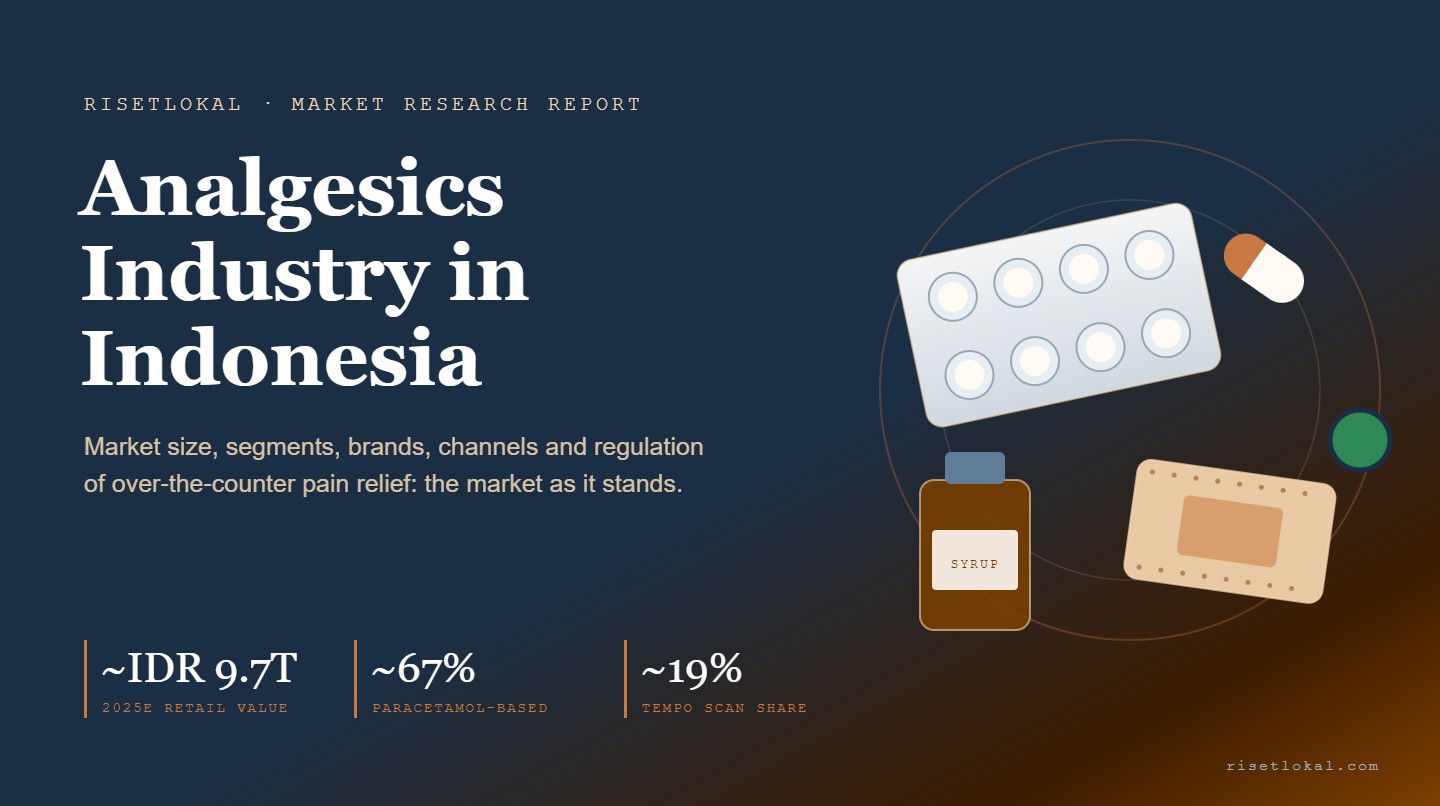
Analgesics Industry in Indonesia: Executive Summary
Notes & sources
1 Results of extrapolation/triangulation using Euromonitor data and other sources: BPS self-medication and population statistics, Ministry of Health pharmacy and pharmacist counts, PT Tempo Scan Pacific Tbk reported sales, BPS inflation, Bank Indonesia exchange rates and RisetLokal analysis. 2025 values are part-year estimates. Shares and values are rounded.
Other sources: BPS, share of population self-medicating (via GoodStats); Ministry of Health, Indonesian Health Profile 2023 (via Databoks); IAI/Ministry of Health pharmacist data (via Investortrust, 2024); Ministry of Health and BPOM statements on acute kidney injury (via IDX Channel, October 2022); company product announcements.
© 2026 RisetLokal. This review is for information only and is not medical or investment advice.
Tags: Analgesics BPOM Consumer Health Download Report Euromonitor Free Download Report Indonesia Konimex Market Research Report OTC Medicine Pain Relief Paracetamol Pharmaceuticals Self-Medication Tempo Scan
*Comments*