10/17 Market Research Report: Alcoholic Drink Industry in Indonesia
Market Research Report | RisetLokal Research Desk
Alcoholic Drink Industry in Indonesia
Market Size, Segmentation, Regulation & Competitive Review (2019–2025)
A review of how Indonesia’s legal alcohol market actually works today: who sells what, through which channels, under which rules, and at what margins. Written for foreign investors, brand owners, importers and analysts sizing up the world’s largest Muslim-majority consumer market.
01 · Executive Summary
A small, tightly regulated market that is quietly getting bigger
Indonesia is not a drinking culture, and the numbers say so. The World Health Organization puts total adult consumption at roughly 0.8 litres of pure alcohol per person per year, of which only about 0.3 litres is recorded, legal product. Yet with more than 280 million people, a 15-million-plus foreign tourist flow and a fast-growing urban middle class, even a thin layer of legal demand adds up to a business worth paying attention to.
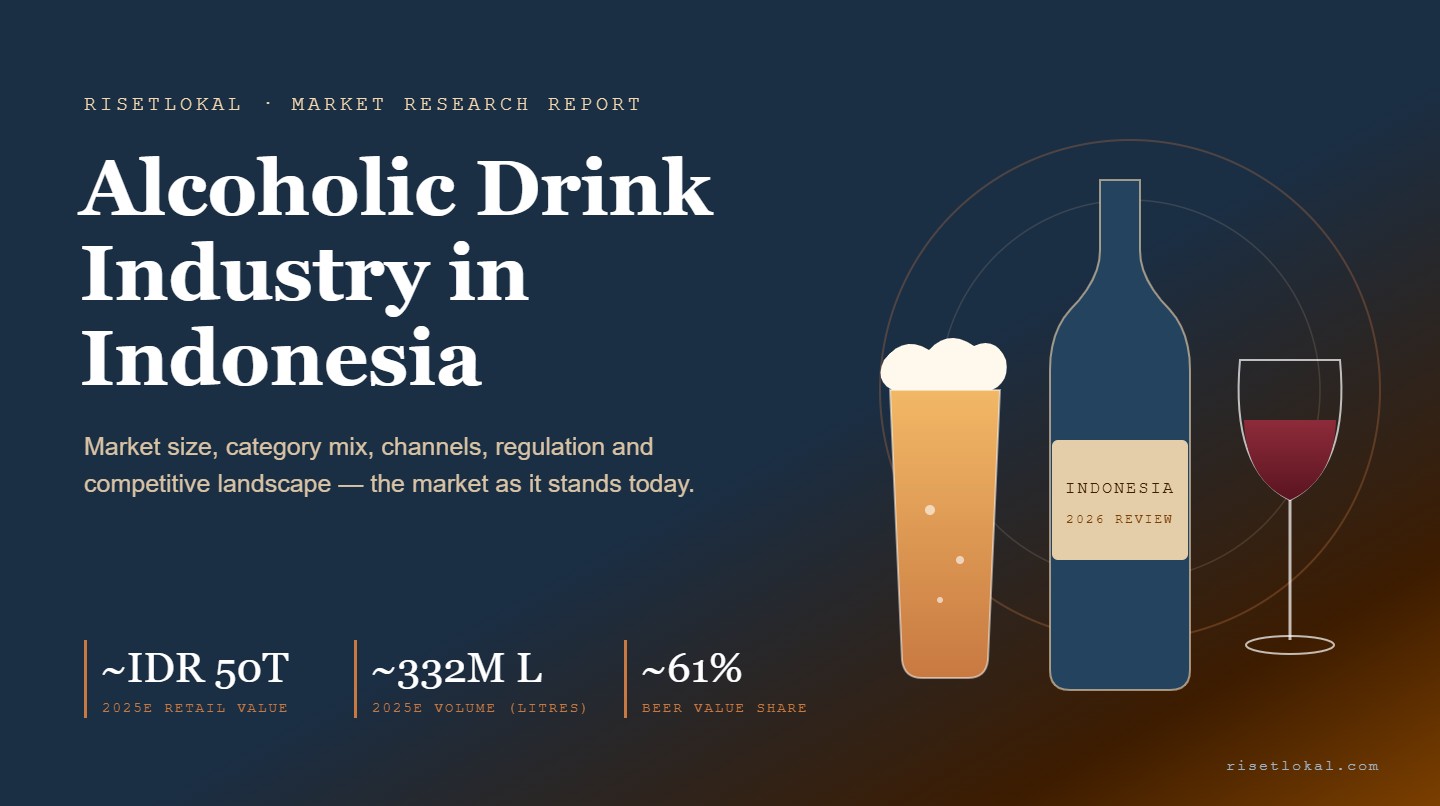
By our estimate, the legal alcoholic drinks market reached about IDR 50 trillion (≈US$3.1 billion) in retail value in 2025, on roughly 332 million litres. That is about a third above 2019 in nominal rupiah, while volume is only around 13% higher. The gap between the two tells most of the story: excise hikes, a richer product mix and the return of bar-and-hotel drinking have pushed value up faster than litres.
Four facts frame the market today:
- Beer is the volume base (over 80% of litres) and is controlled by one company. Multi Bintang Indonesia, Heineken’s local arm, sells well over half of all beer.
- Wine and spirits are where value is moving. Together they now account for close to 39% of sales value, up roughly five points since 2019.
- Tourism is the swing factor. Bali alone welcomed 6.3 million foreign visitors in 2024, and the curve of alcohol sales tracks arrivals closely.
- Regulation is the moat and the ceiling. Import quotas, high excise on imports, a minimarket sales ban and a mass-media advertising ban make entry slow and expensive, but they also shelter incumbents.
02 · Scope & Method
What we measured and how
This report covers legally produced and imported alcoholic drinks sold in Indonesia through retail (off-trade) and bars, restaurants, hotels and clubs (on-trade): beer (including non/low-alcohol beer, as it is sold under beer brands), wine (grape and the locally important fruit and herbal wines), spirits, ready-to-drink (RTD) mixes and cider. Unrecorded alcohol, such as home-distilled arak, tuak and ciu, is discussed but not sized.
Market values are retail selling prices. Our 2019–2024 base draws on syndicated industry data, which we cross-checked and extrapolated to 2025 using company filings on the Indonesia Stock Exchange (Multi Bintang and Delta Djakarta), BPS tourism statistics, Ministry of Finance excise receipts and category momentum. Figures marked 1 are RisetLokal estimates; the footnote at the end explains the basis.
03 · Market Size
From a pandemic collapse to a new high
The pandemic hit this market harder than almost any other consumer category in Indonesia. With bars shut and Bali empty, retail value fell by about 37% in 2020. Recovery came in two steps: domestic reopening in 2021–2022, then the tourist rebound of 2023–2024. Value passed its 2019 level in 2022; volume only caught up in 2023.
Indonesia alcoholic drinks market value, 2019–2025E (IDR trillion)
Recovered past its pre-pandemic level in 2022; 2025 estimate ~34% above 2019 in nominal rupiah
Source: RisetLokal estimates — extrapolation/triangulation using Euromonitor data and other sources. USD at Bank Indonesia average annual rates.
| Indicator | 2019 | 2022 | 2024 | 2025E |
|---|---|---|---|---|
| Retail value (IDR trillion)1 | 37.5 | 38.1 | 46.5 | 50.4 |
| Retail value (US$ billion)1 | 2.65 | 2.57 | 2.94 | 3.06 |
| Total volume (million litres)1 | 293 | 285 | 315 | 332 |
| Foreign tourist arrivals (million, BPS) | 16.1 | 5.5 | 13.9 | 15.4 |
| Alcohol excise receipts, MMEA (IDR trillion, MoF) | — | — | 5.4 (Jan–Aug) | — |
Measured in dollars, growth looks flatter: the rupiah weakened from about 14,150 to roughly 16,450 per US dollar between 2019 and 2025, so a foreign owner booking results in USD has seen only modest gains. That matters for importers whose costs are in euros or dollars.
A useful sanity check comes from the state’s own books. Applying the 2024 excise rates to our estimated legal volumes gives an implied excise bill of roughly IDR 6.9 trillion, against actual alcohol excise receipts of IDR 5.42 trillion in just the first eight months of 2024 (an annualised pace of about IDR 8 trillion). The gap suggests that recorded retail volumes, if anything, understate what leaves licensed breweries and bonded warehouses, partly because hotel and tourist-venue stock is hard for retail tracking to capture.
04 · Market Dynamics
What is pushing the market, and what is holding it back
Drivers
Tourism. BPS recorded 13.9 million foreign arrivals in 2024 and 15.4 million in 2025, closing in on the 16.1 million of 2019. Bali, where drinking is socially normal and the provincial government actively promotes local arak, took in 6.3 million foreign visitors in 2024, already above its pre-pandemic count. When planes are full, beer and wine move.
Tourism and alcohol sales move together
Foreign arrivals vs. alcoholic drinks retail value index (2025 index = estimate)
| Foreign arrivals, million (BPS) | Alcohol value index, 2019 = 100 | |
| 2019 | 16.1 | 100 |
| 2020 | 4.0 | 63 |
| 2021 | 1.6 | 78 |
| 2022 | 5.5 | 102 |
| 2023 | 11.7 | 113 |
| 2024 | 13.9 | 124 |
| 2025 | 15.4 | 134 |
Source: BPS (arrivals); RisetLokal value index — extrapolation/triangulation using Euromonitor data and other sources.
Urban nightlife and the “slow bar”. Jakarta, Surabaya and Bandung have seen a wave of small cocktail and listening bars aimed at Millennials and Gen Z. Music festivals such as We The Fest and Pestapora work as sampling grounds for brands that cannot advertise on TV.
Trading up, selectively. Drinkers are price-conscious at home and willing to spend when out. That split favours mid-priced lager in shops and premium beer, wine and spirits in venues.
Restraints
Religion and social norms. Most Indonesians do not drink, and alcohol remains politically sensitive. A national bill to prohibit alcoholic drinks has been tabled in parliament more than once; it has not passed, but it never fully goes away.
Excise and import costs. The 2024 excise increase raised duty on imported spirits to IDR 152,000 per litre, on top of import duty, 10% VAT and quota-based import licensing.
Illicit and home-made alcohol. Industry players estimate that the black market for spirits could be at least nine times the legal market by volume. Counterfeit excise ribbons and methanol-tainted oplosan remain a recurring public-health story and a real competitor on price.
05 · Segmentation by Category
Beer pays the bills; wine and spirits drive the mix
| Category (2025E)1 | Value (IDR T) | Value share | Volume (M L) | Value growth vs 2024 |
|---|---|---|---|---|
| Beer (incl. non/low alcohol) | 30.5 | 60.6% | 276 | +5.7% |
| Wine (grape, fruit & herbal) | 11.7 | 23.3% | 38 | +12.8% |
| Spirits | 7.7 | 15.4% | 15 | +12.3% |
| RTDs | 0.3 | 0.6% | 2.4 | +5.1% |
| Cider/perry | 0.1 | 0.2% | 0.5 | +1.0% |
Value mix by category: wine and spirits take share from beer
% of total retail value; “Other” = RTDs and cider
Source: RisetLokal estimates — extrapolation/triangulation using Euromonitor data and other sources.
Beer. Mid-priced lager is the heart of the category, led by Bir Bintang. Two sub-segments stand out. Non/low-alcohol beer (Bintang Zero being the best known) has more than doubled since 2019 and now makes up about one litre in seven; it can be sold in minimarkets where regular beer cannot, which is a big distribution advantage. Flavoured and mixed lagers such as Bintang Radler and the beer-and-local-wine hybrid Bintang Anggur Merah have also nearly doubled in volume.
Wine. Foreign readers are often surprised to learn that “wine” in Indonesia is dominated not by imported grape wine but by sweet, locally made fruit and herbal wines, Anggur Merah Orang Tua being the archetype. Bali producers Hatten and Sababay make grape wine from local and imported grapes and have pushed into sangria-style and sweeter styles for younger drinkers.
Spirits. The fastest-growing legal category by volume. Whisky, gin and vodka from Diageo, Pernod Ricard and Moët Hennessy dominate premium bars, while local brands are appearing too, including the first Indonesian single malt and modern bottled arak.
Pricing tells a second story. Dividing value by volume shows the average beer litre has become about 15% dearer since 2019, while wine and spirits have become cheaper per litre as local, lower-priced labels grew faster than imports.
Implied average retail price per litre, 2019 vs 2024
Beer got dearer; wine and spirits got cheaper per litre as local, lower-priced labels gained volume
2019 2024 (IDR ‘000 per litre)
Source: RisetLokal calculation (value ÷ volume) — extrapolation/triangulation using Euromonitor data.
06 · Segmentation by Channel
The bar counter is worth twice the shop shelf
About two in every five litres of alcohol are drunk on-premise. For beer, on-trade takes roughly 43% of volume but about 62% of value, meaning a litre poured in a bar or hotel generates around 2.1 times the retail value of a litre sold in a shop. For a brand owner, winning venues in Bali and South Jakarta is less about volume than about margin and visibility.
Beer: bars, hotels and restaurants punch above their volume
Share of beer sales, 2024 (est.) — a litre sold on-premise earns ~2.1x the value of a litre sold in a shop
Source: RisetLokal estimates — extrapolation/triangulation using Euromonitor data and other sources.
| Off-trade format | Approx. share of off-trade value1 | Role in the market |
|---|---|---|
| Supermarkets | ~25% | Bundles and 5–10% promotions on beer and RTDs |
| Hypermarkets | ~25% | Multipacks, family shopping trips |
| Small local grocers (warung, toko) | ~25% | Single serves; strongest in Bali, Papua, North Sulawesi, NTT |
| Liquor specialists (Red & White, Vines) | ~11% | Imported wine, premium spirits, gifting |
| Convenience stores | ~8% | Mainly non/low-alcohol beer (regular beer barred from minimarkets) |
| E-commerce (age-gated) | ~7%, rising | Fastest-growing; Shopee, Tokopedia, quick-commerce apps |
E-commerce has roughly tripled its share of off-trade value since 2019. It remains small, but for wine and spirits importers without a national distributor it is often the cheapest route to customers outside Bali and Jakarta. The same shift is visible in other categories we track, such as Indonesia’s coffee market, and it rides on the payment rails described in our digital payments in Indonesia report.
07 · Regulatory & Tax Framework
The rules that shape every business decision
Indonesia classifies alcoholic drinks (minuman mengandung etil alkohol, MMEA) into three groups by alcohol content, each with its own excise rate. Rates were raised from 1 January 2024 under Finance Ministry Regulation PMK 160/2023, the first increase for Groups B and C in a decade.
| Group (ABV) | Domestic (IDR/litre) | Imported (IDR/litre) | Change vs previous |
|---|---|---|---|
| A: up to 5% (beer, RTDs) | 16,500 | 16,500 | +10% |
| B: 5–20% (wine) | 42,500 | 53,000 | +29% / +20% |
| C: 20–55% (spirits) | 101,000 | 152,000 | +26% / +9% |
Source: Ministry of Finance, PMK 160/2023; previous rates per PMK 158/2018.
Other rules matter just as much:
- Minimum legal drinking and purchase age: 21 (Trade Ministry Regulation 20/2014).
- No alcohol advertising in mass media; promotion is limited to licensed on-premise venues. Drinks above 20% ABV cannot be advertised at all.
- Minimarket ban. Since 2015, beer may not be sold in minimarkets and convenience stores, which is why non-alcoholic beer variants matter so much for shelf presence.
- Import quotas and licences. Only licensed importers may bring in alcohol, against quotas set partly on tourist arrival forecasts and hotel association demand.
- Investment. Presidential Regulation 10/2021 opened new alcohol manufacturing only in Bali, NTT, North Sulawesi and Papua, where local culture supports it.
- Bali’s arak rules. Governor Regulation 1/2020 legalised and organised the production of traditional Balinese arak, brem and tuak through licensed cooperatives, turning a grey-market spirit into a legal, exportable product now sold at Ngurah Rai airport.
Readers who know our Indonesia cigarettes market report will recognise the pattern: excise is a revenue tool first, and each hike widens the price gap that feeds illicit supply.
08 · Competitive Landscape
One giant, two challengers and a fragmented premium tier
| Company (parent) | Key brands | Est. share of beer volume1 |
|---|---|---|
| Multi Bintang Indonesia (Heineken) | Bir Bintang, Bintang Zero, Radler, Heineken, Guinness | ~57% |
| Delta Djakarta (San Miguel; DKI Jakarta govt 26%) | Anker, San Miguel, Carlsberg (licensed) | ~17% |
| Beverindo Indah Abadi (Orang Tua Group) | Prost, Singaraja | ~12% |
| Bali Hai Brewery Indonesia | Bali Hai, Panther Stout | ~5% |
| Lovina Beach Brewery; craft (Kura-Kura, others) | Stark, Kura-Kura | ~2–3% |
The two listed brewers give a rare look at the economics. Multi Bintang’s numbers show what pricing power looks like in a protected market:
| IDX filings (IDR billion) | MLBI 2024 | MLBI 2025 | DLTA 2024 | DLTA 2025 |
|---|---|---|---|---|
| Net sales | 3,380 | 3,540 | 647 | 675 |
| Net profit | 1,140 | 1,180 | 142 | n/a |
| Net margin | 34% | 33% | 22% | — |
Source: company financial statements via IDX, Kontan, Bisnis.com, IDN Financials. MLBI pays out ~100% of profit as dividends.
A one-third net margin is extraordinary for a brewer anywhere. Multi Bintang has also been gaining ground: its beer volume share rose by about five points between 2020 and 2024, largely at the expense of Delta Djakarta, whose Anker brand has been squeezed by both Bintang and Orang Tua’s cheaper Prost. Delta’s sales are still below their pre-pandemic level of about IDR 800 billion.
Across all alcoholic drinks, Orang Tua is the quiet heavyweight: through Prost, Anggur Merah and its newer arak and highball launches it is the leading domestic group outside Heineken. In spirits, the international majors compete for a small but lucrative premium on-trade, while AB InBev (Hoegaarden) is growing from a tiny base.
09 · Consumer & Product Trends
What Indonesian drinkers are actually buying
| Trend | Evidence in market |
|---|---|
| Mindful drinking | Non-alcoholic beer ~1 in 7 beer litres; Bintang Zero now a top-two beer brand |
| Local flavours | Bir rasa arak, Bintang Anggur Merah, Singaraja Pale Ale, Indonesian single malt |
| Smaller packs | 320 ml cans replacing 330 ml; 180 ml RTD highballs; single serves in warung |
| Casual wine | Sangria-style and sweet wines from Bali producers aimed at under-30s |
| Sustainability | Renewable energy at Multi Bintang’s Sampang brewery; lighter glass from spirits brands |
One structural point is easy to miss: recorded legal consumption is tiny. Converting our 2025 volume estimates into pure alcohol gives roughly 0.1 litres per adult per year, far below WHO’s total estimate that includes home-made and illicit drinks. Put simply, most of the alcohol Indonesians drink never passes through a licensed producer. Formalising even a slice of that demand, as Bali has started doing with arak, is a larger long-term lever than any marketing campaign.
10 · Implications
What this means if you are looking at Indonesia
- Importers of wine and spirits: your real addressable market is Bali, greater Jakarta and a handful of tourist hubs, served through hotels, specialists and age-gated e-commerce. Budget for excise, quota timing and a licensed local partner before anything else.
- Brewers: head-on competition with Bintang in mainstream lager is a hard fight. The open spaces are non-alcoholic, flavoured and premium on-trade, where the incumbent is less entrenched.
- Investors: the listed brewers behave like utilities with pricing power, but the policy risk (excise, prohibition bills, regional bans) is binary and should be priced in.
Looking for the 2026–2030 outlook?
This article reviews the market as it stands. Our Premium Report adds category and channel forecasts to 2030, scenario analysis on excise and regulation, brand-level share data and company profiles. Contact RisetLokal to request it or to commission custom research.
Executive Summary Slides
Alcoholic Drink Industry in Indonesia: Executive Summary
Notes & sources
1 Results of extrapolation/triangulation using Euromonitor data and other sources: IDX filings of PT Multi Bintang Indonesia Tbk and PT Delta Djakarta Tbk, BPS foreign arrival statistics, Ministry of Finance excise data (APBN KiTa), Bank Indonesia exchange rates and RisetLokal analysis. 2025 figures are estimates.
Other sources: BPS; BPS Bali; Ministry of Finance (PMK 160/2023; APBN KiTa 2024); Ministry of Trade Regulation 20/2014; Presidential Regulation 10/2021; Bali Governor Regulation 1/2020; WHO Global Status Report on Alcohol; Kontan, Bisnis.com, IDN Financials, Antara, DDTCNews.
© 2026 RisetLokal. This review is for information only and is not investment advice.
Tags: Alcohol Excise Indonesia Alcoholic Drinks Industry Bali Tourism Delta Djakarta Download Report Euromonitor Free Download Report Indonesia Indonesia Alcohol Market Indonesia Beer Market Indonesia Spirits Market Indonesia Wine Market Market Research Report Multi Bintang
*Comments*