
Market Intelligence Report
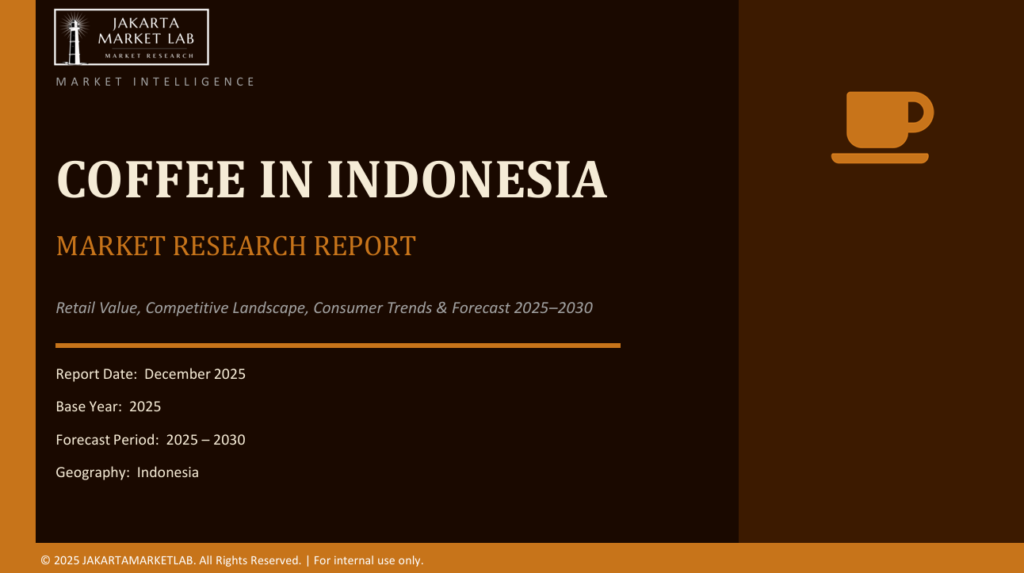
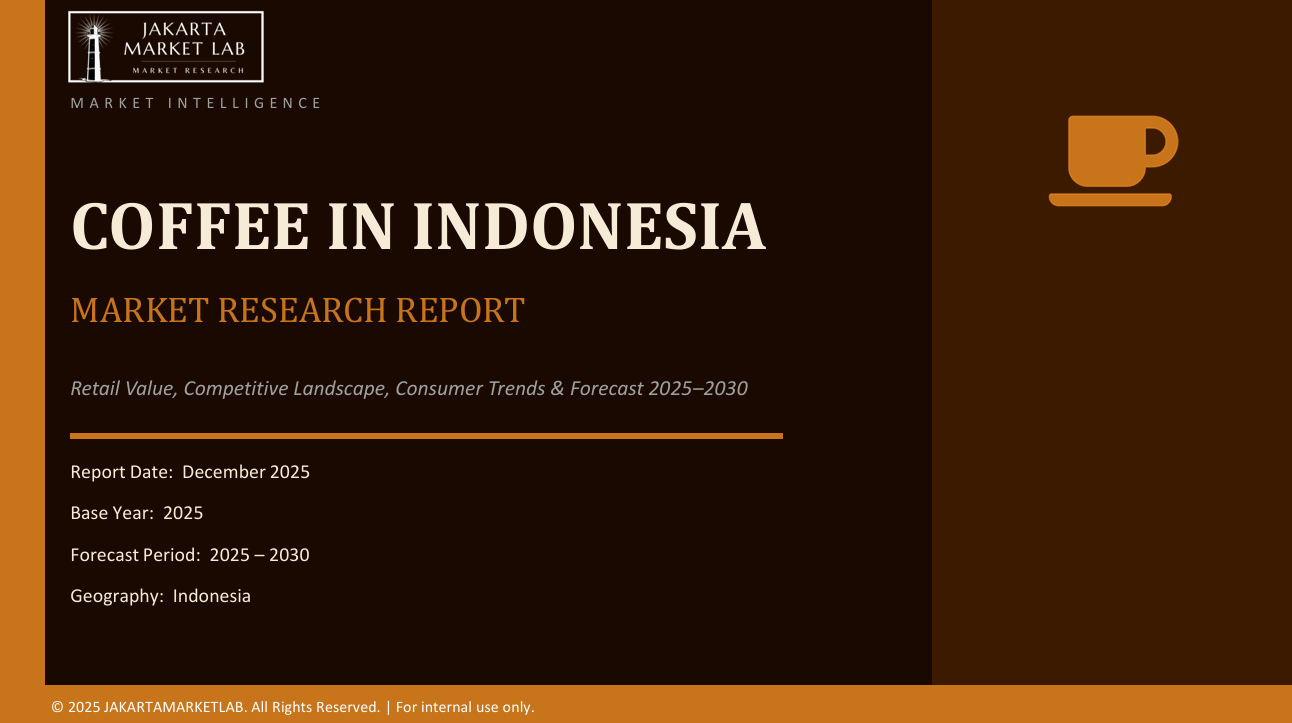
Coffee in Indonesia
Market Research Report 2025
Retail Value, Competitive Landscape, Consumer Trends & Forecast 2025–2030
| Publisher | Geography | Forecast Period | Base Year |
| JakartaMarketLab | Indonesia | 2025 – 2030 | 2025 |
Market Value 2025
IDR 70.3T
+11.6% vs 2024
Historical Value CAGR
9.7%
2020 – 2025
Forecast Value 2030
IDR 78.2T
Projected Retail Value
Forecast Value CAGR
5%
2025 – 2030 (current value)
Section 01
Market Overview: Indonesia’s Coffee Sector at an Inflection Point
Indonesia has long been one of the world’s most consequential coffee markets — a country where the ritual of kopi is not merely a morning habit but a deeply embedded social institution. From the corner warung kelontong that sells single sachets at IDR 1,000 apiece, to urban specialty cafés serving single-origin Gayo Arabica at premium prices, the Indonesian coffee market spans an extraordinary breadth of consumer occasions, price points, and cultural contexts. The retail packaged coffee market — covering fresh coffee beans, fresh ground coffee, coffee pods, instant standard coffee, and instant coffee mixes — reached IDR 70.3 trillion in retail value in 2025, representing a decade of near-uninterrupted structural growth that has transformed the industry from a largely commoditised staple into a dynamic, innovation-driven consumer category.
What makes the 2025 market particularly telling is the divergence between value and volume trajectories. Retail value surged 11.6% year-on-year — driven almost entirely by price increases rather than consumption growth — while retail volume contracted a modest 0.4%, to approximately 743,000 metric tonnes. This decoupling signals a structurally mature market where incumbent brands compete intensely for value share through premiumisation, flavour innovation, and channel diversification rather than through organic volume expansion. The market’s engine of growth has fundamentally shifted: price architecture, consumer trade-up behaviour, and the emergence of new consumption occasions (convenience stores, e-commerce) are now the primary levers of commercial performance.
Underpinning the market’s resilience is Indonesia’s position as the world’s fourth-largest coffee producer, with approximately 794,000 metric tonnes of output annually — approximately 75% Robusta from South Sumatra and Lampung, and 25% Arabica from the highland origins of Gayo, Mandheling, Toraja, and Flores. This deep upstream integration gives Indonesian coffee manufacturers structural cost advantages and an authentic provenance story that is increasingly leveraged at the premium end. The confluence of strong cultural demand, a growing middle class, and a world-class domestic supply chain sets Indonesia apart from almost every other emerging-market coffee story globally.
“Price hikes — not volume growth — drove 12% current value expansion in 2025. Indonesia’s retail coffee market is structurally mature, but the premium opportunity is only just beginning to unfold.”
— JakartaMarketLab Lead Analyst, Coffee in Indonesia Report 2025
Section 02
Market Sizing: A Tale of Two Categories
The Indonesia retail coffee market is divided into two broad super-categories: Fresh Coffee (encompassing fresh coffee beans and fresh ground coffee, including pods) and Instant Coffee (comprising instant standard and instant coffee mixes). These two categories occupy very different strategic spaces. Fresh coffee — particularly standard fresh ground — anchors the mass market through the nation’s ubiquitous sachet distribution model, while instant coffee mixes sit at the intersection of affordability, convenience, and flavour experimentation. The market’s evolution from 2020 to 2025 tells a consistent story: value has grown faster than volume across every segment, confirming a market-wide premiumisation dynamic even at the mass end.
Fresh coffee beans, while small in absolute terms, posted a historical value CAGR of over 20% between 2020 and 2025 — the fastest-growing subcategory in the entire market — fuelled by specialty coffee awareness and the rise of home brewing among urban middle-class consumers. At the other end, instant coffee mixes — the dominant volume segment — maintained resilience by deliberately suppressing price increases to protect their mass-market consumer base, a calculated margin-for-volume trade-off that reflects the segment’s strategic importance to incumbent players.
🔒
Full Category Breakdown — Available in the Paid Report
The complete report contains year-by-year retail value (IDR billion) and volume (metric tonnes) data for all five product categories from 2020 through 2030, including category-level CAGRs, value mix tables, and volume mix analysis.
Category data, subcategory splits, price-per-kg trends, and channel matrices are locked behind the full report.
Section 03
Consumer Trends Reshaping the Market
Six macro trends are actively re-shaping the Indonesia coffee competitive landscape through 2030. Two are highlighted below — the full set is available in the paid report.
⭐
Premiumisation Wave
Indonesia’s rising middle class — estimated at 53 million consumers by 2025 — is actively trading up to specialty and origin-specific coffees. Gayo Arabica and Toraja beans command a 3–5× retail price premium over commodity Robusta, and fresh coffee beans posted a value CAGR exceeding 20% between 2020 and 2025. Third-wave café culture in Jakarta, Surabaya, and Bali is spilling over into retail purchasing behaviour, elevating consumer expectations for transparency, provenance, and sensory complexity.
🌐
E-Commerce as a Disruptive Channel
Indonesia’s e-commerce ecosystem — led by Shopee, Tokopedia, and Blibli with over 130 million monthly active users collectively — has emerged as the fastest-growing distribution channel for coffee in 2024–2025 by volume. Brands are leveraging flash sales, cross-category bundling, and online-exclusive premium SKUs to capture digitally-native consumers. Social commerce via TikTok Shop is an accelerating sub-trend particularly relevant for specialty micro-brands targeting younger cohorts.
🔒
Get the Full Report to Access Trends #3 through #6: GenZ & Alpha Demographic Targeting · Health-Conscious Consumption · Convenience & Customisation Formats · Sustainability & Traceable Sourcing — including quantitative benchmarks, brand-level examples, and strategic implications for each trend.
Section 04
Competitive Landscape: Concentration at the Top, Disruption Below
The Indonesian retail coffee market is characterised by pronounced concentration at the top, with the three leading players collectively accounting for the majority of retail value. Below this dominant tier, a set of aggressive challenger brands are actively taking share through promotional intensity, distribution expansion, and targeted innovation — creating a competitive environment that has intensified meaningfully over the past four years.
🏆 Santos Jaya Abadi — Undisputed Market Leader
The house of Kapal Api, ABC Susu, Good Day, and Excelso remains the defining force in Indonesian coffee retail. Santos Jaya Abadi maintains the broadest category presence of any player — spanning standard fresh ground, instant mixes, coffee beans, and premium specialty — and commands the deepest warung-level distribution infrastructure in the country. In 2024–2025, the company celebrated its centenary with an ambitious consumer engagement campaign spanning aspirational prizes and nationwide warung activations, while simultaneously launching health-forward sachet innovations targeting Gen Z and Alpha demographics. Its competitive moat is structural: no challenger can replicate its combination of brand equity, manufacturing scale, and last-mile distribution reach in the near term.
#2 Java Prima Abadi — White Coffee Dominance
Java Prima Abadi has built a remarkably resilient #2 position on the back of a single-brand phenomenon: Luwak White Koffie. The brand’s Ipoh-style white coffee format tapped into a consumer preference shift that competitors were slow to recognise, and the company has maintained above-15% retail value share consistently from 2021 through 2025 — an achievement unusual in a market as competitive and fragmented as Indonesian packaged coffee. The company’s concentrated brand architecture, however, creates strategic vulnerability to white coffee category saturation as the format matures and competitors launch white-coffee variants of their own.
#3 Mayora Indah — The Volume Growth Challenger
Mayora Indah’s coffee portfolio — anchored by Torabika and its flavour-forward sub-brands — delivered the strongest volume growth among the top players in 2025, driven by aggressive promotional mechanics and strategic cross-category bundling on e-commerce platforms. Torabika’s “20% more and thicker” product messaging has proven effective at sustaining warung-level purchase frequency, while the Torabika Creamy Latte launch positioned Mayora within the growing health-conscious customisation segment. With a stable share position and the full leverage of its extensive FMCG distribution infrastructure, Mayora remains a formidable #3 with realistic ambitions to close the gap on Java Prima.
🔒
Full Share Tables & Brand-Level Data — Locked
The full report includes company retail value share data (%) for 8 named players across 2021, 2023, and 2025; brand share data for the top 8 brands; NBO and LBN share evolution tables; in-depth profiles for the Top 5 players covering key financials, innovation pipelines, channel strategies, and market actions in 2024–2025; and a complete Porter’s Five Forces analysis.
All share percentages, brand rankings, and player-level analytics are available exclusively in the paid report.
Section 05
Outlook & Forecast 2025–2030: Value Growth, Volume Discipline
The Indonesia retail coffee market is forecast to reach IDR 78.2 trillion by 2030, representing a compound annual growth rate of approximately 5% on a current value basis over the 2025–2030 forecast horizon. This trajectory reflects a market that has found its structural rhythm: value appreciation driven by premiumisation, mix shift toward higher-ASP categories, and moderate inflationary pass-through — rather than the volume-led expansion of an earlier growth era. Volume is expected to grow at just 0.2% CAGR through 2030, confirming that the next chapter of Indonesian coffee is fundamentally a value story, not a unit story.
Within this moderating headline, however, pockets of genuinely elevated structural growth exist. Coffee pods — currently representing a fraction of total retail volume — are projected to grow at the fastest category CAGR through 2030, anchored by the spread of pod-compatible machines among urban middle-income households and the exclusive availability of premium pod SKUs on e-commerce platforms. The outer island markets of Kalimantan, Sulawesi, and Papua represent a meaningful white-space volume opportunity as logistics infrastructure improves and consumer incomes converge toward Java-level spending capacity. Sustainability credentials, meanwhile, are set to transition from a premium differentiator to a baseline expectation for export-facing SKUs and upmarket domestic retail by 2027–2028 — reshaping the supplier certification landscape across the value chain.
The strategic imperative for market participants through 2030 is clear: those who invest in brand architecture capable of spanning mass-market loyalty and premium aspiration simultaneously — while building defensible digital commerce capabilities — will be best positioned to capture disproportionate value in a market that rewards complexity management. The race is on for the next generation of Indonesian coffee consumer, and the competitive landscape will look meaningfully different in 2030 than it does today.
“Indonesia’s retail coffee market is on track to reach IDR 78.2 trillion by 2030. The next five years will be defined not by who sells the most cups, but by who captures the highest value per cup — and who wins the hearts of Indonesia’s 72 million Gen Z and Alpha consumers.”
— JakartaMarketLab Forecast Analysis, December 2025
Section 06
What the Full Report Includes
The Coffee in Indonesia Market Research Report 2025 by JakartaMarketLab is a comprehensive 27-slide intelligence document covering every dimension of the Indonesian retail coffee market. Here is what you get:
Market Sizing & Category Segmentation
Full retail value (IDR billion) and volume (metric tonnes) data by product category — fresh beans, fresh ground, pods, instant standard, and instant mixes — covering 2020 through 2030 with annual granularity and category-level CAGRs.
Distribution Channel Analysis
Channel volume and value share across warung kelontong, supermarkets/hypermarkets, convenience stores, retail e-commerce, and other channels — with trend direction and strategic implications for each.
Company & Brand Share Tables (2021–2025)
Full NBO and LBN share data for the top 8 companies and top 8 brands, with multi-year share evolution and gain/loss analysis across the 2021–2025 period.
Top 5 Company Profiles
In-depth profiles of Santos Jaya Abadi, Java Prima Abadi, Mayora Indah, Nestlé Indonesia, and Wings Food — covering key financials, brand portfolios, innovation pipelines, channel strategy, and 2024–2025 market actions.
2025–2030 Forecast & Strategic Outlook
Annual retail value and volume forecasts through 2030 by category, with value and volume CAGRs, the innovation roadmap for key players, and five strategic outlook scenarios for market participants.
Consumer Mega Trends (6 Trends)
Full coverage of all six macro trends reshaping the market — premiumisation, e-commerce disruption, GenZ/Alpha targeting, health-conscious consumption, convenience & customisation, and sustainability — with brand examples and quantitative benchmarks.
Industry Regulations & Compliance Landscape
Comprehensive regulatory analysis covering BPOM product registration requirements, SNI quality standards, BPJPH Halal certification obligations, packaging & labelling rules, and the pending sugar excise tax risk and its implications.
Industry Value Chain & Porter’s Five Forces
End-to-end value chain mapping from smallholder farm gate to retail RSP, with indicative value addition at each stage, plus a structured Porter’s Five Forces analysis assessing competitive intensity, supplier/buyer power, and entry barriers.
Full Intelligence Report
Coffee in Indonesia Market Research Report 2025
Get the complete market intelligence — category data, company share tables, brand rankings, regulatory landscape, and 2030 forecasts — in a single comprehensive report.
Publisher
JakartaMarketLab
Pages / Slides
27 Slides
Geography
Indonesia
Forecast Period
2025 – 2030
Base Year
2025
This article is a promotional summary of the full market research report published by JakartaMarketLab. Selected statistics are shown for indicative purposes only. Complete data and methodology are available in the full report. © 2025 JakartaMarketLab. All Rights Reserved.
© 2025 JakartaMarketLab Market Intelligence | www.jakartamarketlab.com