10/18 Market Research Report: Appliances and Electronics Specialists Industry in Indonesia
Market Research Report | RisetLokal Research Desk
Appliances and Electronics Specialists Industry in Indonesia
Market Size, Store Network, Retailers, Smartphone Dominance, Channels & Regulation (2019–2024)
How Indonesia’s electronics and appliance stores work today: how much they sell, why there are fewer of them every year, and how one retailer came to control more than half of the channel.
01 · Executive Summary
A shrinking channel with one dominant winner
Indonesia’s appliance and electronics specialist stores sold about IDR 42 trillion (around US$2.7 billion) in 2024, through roughly 5,000 outlets. Sales grew 3.5% in 2024, the fourth year of recovery after a one-third collapse in 2020. They are still about 12% below 2019 in rupiah, and about 23% below after inflation.
The most striking thing about this market is not its size but its structure. Erajaya Swasembada, the phone and gadget retailer behind Erafone and iBox, has grown from about a third of specialist store sales in 2020 to about 57% in 2024. Over the same period, more than a thousand independent electronics shops closed.
Four facts frame the market today:
- Smartphones drive the channel. Phones and tablets are the largest product group, and instalment plans let middle- and lower-income buyers upgrade.
- Consolidation is extreme. Erajaya’s banners alone, Erafone and iBox, hold about 46% of specialist sales. The next chain, Electronic City, holds about 5.5%.
- Fewer, bigger, suburban stores. Outlet numbers fell 19% between 2019 and 2024. Growth now comes from stand-alone stores in suburbs and second- and third-tier cities rather than malls.
- Online is the real rival. Marketplaces sell phones, TVs and small appliances at sharp prices. Store chains answer with after-sales service, fast delivery and 0% instalments.
02 · Scope & Method
What we measured
This report covers store-based retailers whose main business is consumer electronics and appliances: smartphones and tablets, computers, TVs and audio, cameras, and large and small household appliances. Examples are Erafone, iBox, Electronic City, Hartono and independent electronics shops. Hypermarkets, department stores and pure online sellers are outside the market size, although we discuss them as competitors. Values are retail sales excluding sales tax.
Figures marked 1 are RisetLokal estimates. Our base series comes from syndicated retail tracking. We rounded it and cross-checked it against the reports of listed retailers (Erajaya Swasembada, Electronic City Indonesia), BPS inflation and government rules on phone imports. Dollar values use Bank Indonesia average annual exchange rates.
03 · Market Size
IDR 42 trillion, still below its pre-pandemic peak
Sales through appliance and electronics specialist stores, 2019–2024 (IDR trillion)
Still about 12% below 2019 in rupiah after the pandemic drop
Source: RisetLokal estimates — extrapolation/triangulation using Euromonitor data and other sources. Store-based retail value; USD at Bank Indonesia average annual rates.
| Year | Store sales (IDR trillion)1 | Growth | Outlets1 | Selling space (‘000 m²)1 |
|---|---|---|---|---|
| 2019 | 48.0 | – | 6,170 | 3,050 |
| 2020 | 31.6 | −34% | 5,870 | 2,900 |
| 2021 | 35.5 | +12% | 5,590 | 2,760 |
| 2022 | 39.3 | +11% | 5,210 | 2,660 |
| 2023 | 40.9 | +4% | 5,100 | 2,510 |
| 2024 | 42.3 | +3.5% | 5,000 | 2,540 |
Unlike many retail channels, this one has not returned to 2019 levels, and growth has slowed every year since 2021. Two forces explain it. First, many electronics purchases moved online during the pandemic and stayed there. Second, weaker spending among lower- and middle-income households in 2024 hit big-ticket items first.
Store productivity, however, has improved. With fewer outlets, the average store sold about IDR 8.5 billion in 2024, up from IDR 7.8 billion in 2019, or about IDR 16.7 million per square metre. The average store is about 500 square metres. The channel is consolidating into fewer, busier stores.
04 · Segmentation
Phones lead, appliances are the growth add-on
| Product group | Role in specialist stores | Main retailers |
|---|---|---|
| Smartphones and tablets | Largest sales driver; frequent upgrades financed by instalments | Erafone, iBox, Oke Shop, brand stores |
| Computers and accessories | Steady; laptops for school and work | iBox (Apple), Erafone & More, Electronic City |
| TVs and audio | Big-ticket items, sensitive to promotions | Electronic City, Hartono, independents |
| Large appliances | Fridges, washing machines and ACs; delivery and installation matter | Electronic City, Erablue, Courts, independents |
| Small appliances and gadgets | Add-on sales, wearables, drones, cameras | Erafone & More, Erablue, iBox |
Phone retailers have been moving into appliances to raise the value of each visit. Erajaya opened its first Erafone & More store in Margonda, Depok, in September 2022, combining phones with laptops, TVs and household devices. It also built Erablue, a chain of stand-alone appliance and electronics stores aimed at suburban and smaller-city shoppers. For one big-ticket appliance category, see our air conditioners report.
05 · Competitive Landscape
Erajaya and then a long gap
Share of specialist store sales, 2020 vs 2024
The leader went from a third of the channel to more than half
Navy = Electronic City (~5–6%).
Source: RisetLokal estimates — extrapolation/triangulation using Euromonitor data and other sources.
Erajaya versus everyone else: specialist store sales (IDR trillion)
Erajaya’s store sales more than doubled while the rest of the channel shrank
| Year | Erajaya chains1 | Electronic City1 | All other specialists1 |
|---|---|---|---|
| 2020 | 11.2 | 1.5 | 19.0 |
| 2021 | 14.0 | 1.7 | 19.9 |
| 2022 | 16.9 | 2.0 | 20.3 |
| 2023 | 20.6 | 2.3 | 18.0 |
| 2024 | 24.0 | 2.3 | 16.0 |
Source: RisetLokal estimates — extrapolation/triangulation using Euromonitor data and other sources.
Erajaya Swasembada is the clear leader. It is both Indonesia’s largest phone distributor and its largest gadget retailer. Its banners include Erafone, Erafone Megastore, Erafone & More, Erablue and iBox, an Apple Premium Partner. Group revenue was IDR 65.3 trillion in 2024 and IDR 76.6 trillion in 2025, up 17%, with phones and tablets making up about 78% of 2025 sales. The group ended 2025 with 2,333 retail outlets. That figure is larger than the specialist store numbers above because it also counts lifestyle, sportswear and food-and-beverage stores and wholesale distribution.
Electronic City, a listed chain of mall-based electronics and appliance stores with about 60 outlets, is a distant second at about 5.5%. Regional chains such as Hartono in East Java, Courts and Oke Shop are each below 1%. Best Denki, the Japanese chain that had 27 Indonesian stores in 2021, has not been present in the market since 2022.
Brand share of specialist store sales, 2024 (approx.)
Two Erajaya banners hold about 46%
Source: RisetLokal estimates — extrapolation/triangulation using Euromonitor data and other sources.
Brand-owned stores are a third force. Samsung, Xiaomi, OPPO and vivo run or license their own experience stores and kiosks, and Apple sells through Premium Partners such as iBox and Digimap rather than its own store. These outlets are often operated by distributors, including Erajaya itself, which is one reason the leader’s share keeps rising. For a brand, the choice is less between Erajaya and a rival chain than between Erajaya’s stores, its own branded outlets and online marketplaces.
06 · Store Network
Erajaya opens, independents close
Store network, 2021 → 2024
Number of outlets: Erajaya added ~860 stores while independents closed ~1,400
2021 → 2024: Erafone 287 → 936 · Megastore 99 → 226 · iBox 75 → 162 · independents and others ~4,970 → ~3,560 · total ~5,590 → ~5,000
Source: RisetLokal compilation from retail tracking and company data (store counts as reported, rounded where marked ~).
Between 2021 and 2024, Erafone stores more than tripled, from 287 to 936, and iBox doubled. At the same time, independent and smaller-chain outlets fell by about 1,400. The network is being rebuilt around a single operator’s brands.
The location strategy has also changed. New stores are increasingly stand-alone shops outside malls, in suburbs and second- and third-tier cities, where rents are lower and lower- and middle-income buyers are easier to reach. Erajaya pairs these stores with an offline-to-online model. Shoppers can browse and pay online, then pick up or get delivery from the nearest store. After-sales service is part of the pitch: fast warranty handling, one-day installation for appliances and replacement of faulty devices within 15 days.
07 · Demand Drivers & Constraints
Connected consumers, stretched budgets
| Indicator | Value | Why it matters |
|---|---|---|
| Internet users (APJII, 2024) | ~221.6 million (79.5% of population) | A large, connected base that upgrades phones regularly |
| Middle-class population (BPS) | 57.3m (2019) → 47.9m (2024) | The core buyers of mid-range phones and appliances shrank |
| Consumer inflation, Dec 2024 (BPS) | 1.57% | 2024 growth was mostly volume and mix, not price |
| Specialist outlets, 20241 | ~5,000 | Down about 19% from 2019 as independents closed |
| Average store size, 20241 | ~500 m² | Larger formats that mix phones with appliances |
Indonesia is a phone-first market. Most people go online through a smartphone, many own more than one SIM card, and new models from Samsung, Apple, Xiaomi, OPPO and vivo get heavy promotion. That keeps a steady flow of upgrade purchases even when budgets are tight. Buyers simply stretch the payment over 6 to 12 months.
The calendar matters too. Spending peaks before Eid al-Fitr, when many workers receive their religious holiday allowance (THR), and again at back-to-school time and during year-end online shopping days such as 12.12 (Harbolnas). Store chains plan launches and instalment offers around these dates.
The main constraint is the squeeze on the middle class. BPS counts about 9.5 million fewer people in the middle class in 2024 than in 2019. These households buy mid-range phones, TVs and washing machines. When they delay, the independent shops that serve them are hit first. That is one reason the long tail of the channel keeps shrinking while Erajaya, with its finance partners and wider reach, keeps growing.
08 · Channels, Payments & Promotions
Instalments, cashback and the online price war
| Tool | How it is used |
|---|---|
| 0% instalments | Offered with partner banks and consumer-finance firms; key for phones and large appliances |
| Cashback and vouchers | Weekend price promotions, weekly draws and loyalty points (e.g. EraClub) |
| Fast delivery | Some chains guarantee delivery within six hours in major cities |
| Shopping festivals and roadshows | Time-limited events with exclusive bundles |
| Exchange guarantees | Replacement of damaged goods to win trust against online sellers |
Marketplaces such as Shopee, Tokopedia and Lazada, along with brands’ own official stores, compete on price. Store chains cannot always match them, so they compete on trust, warranty and financing. Digital payment and paylater options (see our digital payments report) have blurred the line between the two channels.
09 · Regulatory Environment
IMEI registration and local-content rules shape what can be sold
| Rule | Effect on retailers |
|---|---|
| IMEI registration (since 2020) | Phones not registered with the government are blocked from local networks, which shrinks the grey market and favours official retailers |
| Local-content (TKDN) rule for 4G/5G phones | At least 35% local content is required before a phone can be certified for sale |
| iPhone 16 delay | The iPhone 16 could not be sold officially in Indonesia until 11 April 2025, when its certification was completed at 40% local content |
| SNI for household electronics (Permenperin 7/2025) | Mandatory standards for many appliances from July 2025 |
| Energy-efficiency labels | Required for ACs, fridges and other appliances; stores display star ratings |
These rules matter more here than in most retail. The iPhone 16 episode showed how a single certification decision can remove a top product from shelves for months. That hit iBox and every Apple reseller in the busiest selling season. IMEI registration, on the other hand, has helped official chains by making unofficial imports riskier for buyers.
10 · Implications
What this means if you are looking at Indonesia
- Brands: reaching Indonesian shoppers in stores largely means working with Erajaya. Local-content certification needs to be planned well before a launch.
- Retail entrants: mall electronics retail is mature and shrinking. The space that remains is in suburban stand-alone stores, appliance specialists, and regional chains with strong delivery and installation.
- Investors and lenders: consumer finance is the engine of the channel. Instalment availability and credit quality matter as much as product launches.
Looking for the 2026–2030 outlook?
This article reviews the market as it stands. Our Premium Report goes deeper with segment and channel detail, a cost structure overview (rent, staff, inventory financing, consumer-credit fees and supplier margins), full competition analysis with company profiles, consumer behaviour analysis, the industry’s mega trends, and forecasts to 2030. Contact RisetLokal to request it or to commission custom research.
Executive Summary Slides
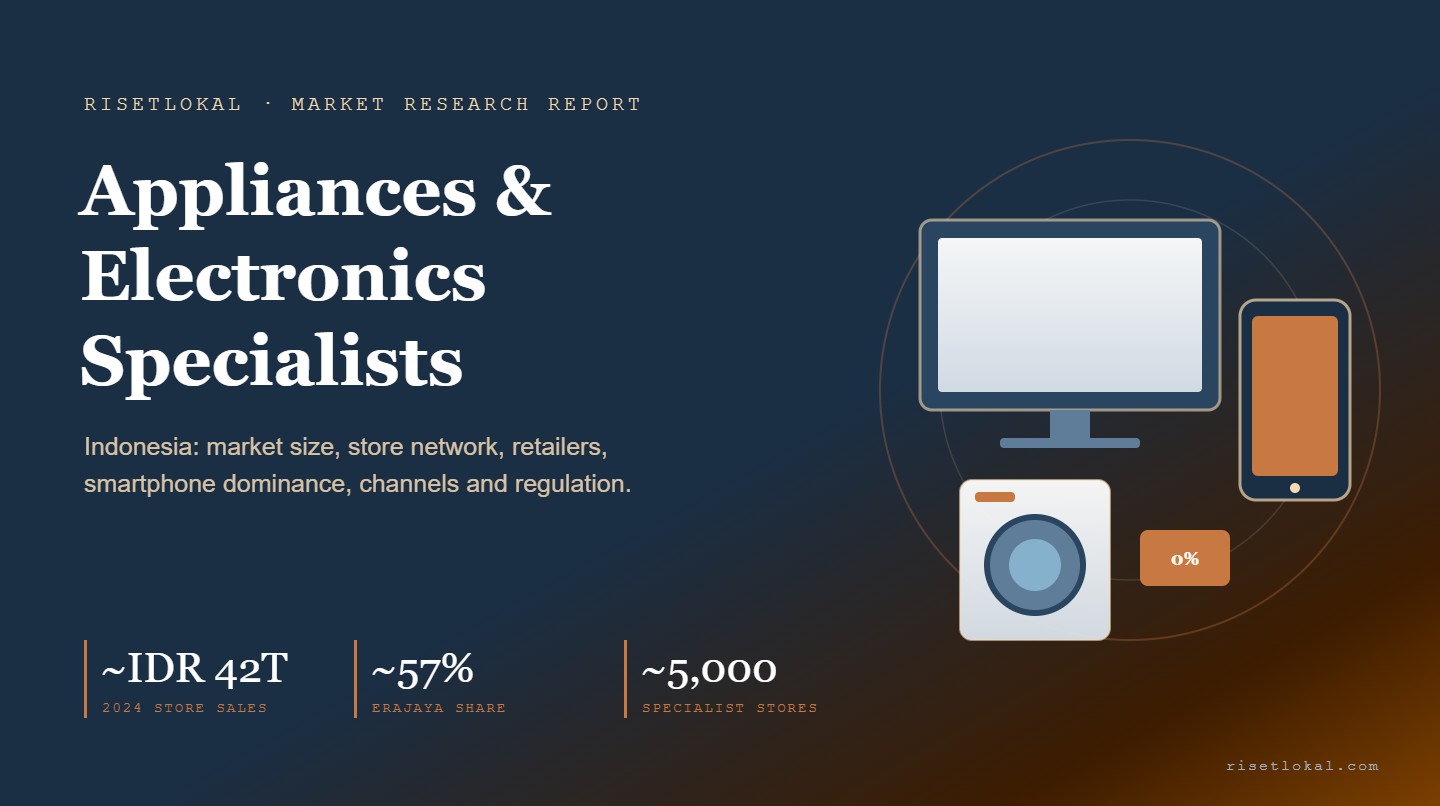
Appliances and Electronics Specialists Industry in Indonesia: Executive Summary
Notes & sources
1 Results of extrapolation/triangulation using Euromonitor data and other sources: PT Erajaya Swasembada Tbk and PT Electronic City Indonesia Tbk reports, BPS inflation, Ministry of Industry and Komdigi rules, Bank Indonesia exchange rates and RisetLokal analysis. Store counts are as reported by retail tracking. Shares and values are rounded.
Other sources: APJII internet survey 2024; BPS middle-class statistics (August 2024); Erajaya FY2025 results (via Bisnis.com, March 2026); iPhone 16 sale date (via Bisnis.com, March 2025); Ministry of Industry Permenperin 29/2017 and 7/2025; company announcements.
© 2026 RisetLokal. This review is for information only and is not investment advice.
Tags: Consumer Appliances Consumer Electronics Download Report Electronic City Electronics Retail Erajaya Euromonitor Free Download Report Home Appliances Indonesia Market Research Report Omnichannel Retail Smartphones TKDN
*Comments*